Event 1
Rose McGowan’s 1997 alleged assault and settlement

[Rose McGowan](entity:character-recall-character-rose-mcgowan-ff89b5d83c63)’s account of an alleged 1997 assault by [Harvey Weinstein](entity:character-recall-character-harvey-weinstein-f7123ea4807b) describes how a meeting with a powerful film producer became, in her telling, an assault and was followed by a settlement. The episode mattered both for its personal consequences and for the challenge it posed to reporters: McGowan said Weinstein paid her $100,000, but the agreement could support her account without proving what had happened in the hotel room or resolving a public dispute between the two.
## Sundance and the meeting
McGowan placed the episode during a successful period early in her acting career, at the Sundance Film Festival in [Park City, Utah](entity:location-recall-location-1b2d19fa106f). She had appeared in only four or five films, including Scream, but several of her new movies were at the festival, television crews followed her, and she moved among premieres and parties. She later could not remember the year with certainty, recalling the period through the film being shown rather than a calendar date. The screening she remembered was for Going All the Way, where she had been seated near Weinstein.
Weinstein’s presence at Sundance carried weight in that setting. He was a producer-distributor who had acquired small films such as Clerks and Reservoir Dogs and helped turn them into cultural touchstones. After the screening, he asked to meet McGowan. She understood the invitation as a plausible professional encounter between an influential producer and a rising actor. They met in Weinstein’s room at [Stein Eriksen Lodge Deer Valley](entity:location-recall-location-stein-eriksen-lodge-7a2f2b710af2). McGowan said their conversation initially concerned films and roles.
## McGowan’s account and the settlement
McGowan said that, as she was leaving, Weinstein drew her into an adjoining room and assaulted her. She recalled an intense shock and described mentally distancing herself from the situation as a way to endure it and leave. Her account included a deliberate effort to make the encounter end and get out of the room; in her telling, the meeting’s professional premise had given way to a situation in which she was trying to regain her safety.
Within days, McGowan said, Weinstein left a message on her home answering machine in [Los Angeles](entity:location-recall-location-los-angeles-11eff639bdf5). She recalled it as an offer to join a circle of women he described as his special friends. Shocked and distressed, she complained to her managers and retained a lawyer. The matter ended in a $100,000 settlement from Weinstein. McGowan said she donated the money to a rape crisis center. The settlement did not include an admission of wrongdoing on Weinstein’s part, and McGowan said she was never given a copy of the agreement. That missing document would later matter to journalists trying to establish whether the payment could be independently verified.
McGowan understood the episode as part of a broader structure, not simply a private conflict with one producer. She described [Hollywood](entity:location-recall-location-hollywood-3ce8b1af5069) as a system that drew women in with the promise of fame, made profitable products of them, treated their bodies as property, demanded perfection, and discarded them. Her account therefore connected the particular meeting and settlement to a wider claim about how women’s careers and bodies could be controlled within the entertainment business.
## Reporting and the limits of corroboration
When [Jodi Kantor](entity:character-recall-character-jodi-kantor-0151139c3346) first spoke with McGowan, she agreed to keep the conversation private until they decided otherwise. That arrangement made room for an initial account without committing McGowan to publication. It did not remove the journalistic burden that would follow: before [The New York Times](entity:organization-recall-organization-the-new-york-tim-bb503dc75ff2) could consider publishing the allegations, reporters would need corroboration and would have to give Weinstein an opportunity to respond. Kantor brought what she had learned to her editor, [Rebecca Corbett](entity:character-recall-character-rebecca-corbett-4fd0a83fce5e), and they considered whether the account could be supported and whether other women had similar experiences.
The account presented a particular evidentiary difficulty. Weinstein could dispute McGowan’s recollection, and the fact that she said she had tried to end the encounter in a way that would help her leave could be misrepresented as evidence that she had welcomed it. The answering-machine message might have helped establish how Weinstein used his influence, but McGowan had only her memory of a message from years earlier, not a recording reporters could examine. Without additional evidence, the story risked becoming a he-said, she-said dispute in which readers chose sides rather than assessing independently documented facts.
The settlement offered a different kind of lead. It could not prove what happened in the room, but it could establish that Weinstein had paid McGowan a significant sum at the time to settle a dispute. The reported involvement of lawyers, a signed agreement, the transfer of money, and McGowan’s donation to a rape crisis center pointed toward records or people who might confirm parts of the history. Finding documentation was expected to be difficult; the agreement itself was not in McGowan’s possession. Its potential value lay in corroboration of the aftermath, not as a conclusive account of the alleged assault.
## Significance and unresolved questions
For the investigation, McGowan’s story was both a serious allegation and a test of how to report one fairly. A single account could be challenged and publicly reduced to competing versions. A documented settlement might strengthen the account without answering every question. The distinction mattered: careful reporting could neither treat payment as proof of the alleged assault nor ignore its potential to confirm that a dispute had been resolved with a substantial sum.
The episode also illustrates the difference between a person’s willingness to speak and the availability of evidence that can withstand scrutiny. McGowan described reporting her experience to managers, retaining counsel, reaching a settlement, and donating the payment, yet said she lacked the agreement itself. Her account thus directed the reporters toward an archive that might exist outside her possession. At the point described in the investigation, the settlement’s documentation remained a question to pursue, and the alleged events in Weinstein’s room remained McGowan’s account rather than something the settlement alone could establish.
Event 2
1998 Venice Film Festival incident and Miramax settlement
The [1998 Venice Film Festival incident and Miramax settlement](entity:event-recall-event-1998-a471d76e795a) began with [Rowena Chiu](entity:character-recall-character-rowena-chiu-cd5672993973)’s account of [Harvey Weinstein](entity:character-recall-character-harvey-weinstein-f7123ea4807b)’s conduct during a work trip and ended in a legal agreement that restricted what she and [Zelda Perkins](entity:character-recall-character-zelda-perkins-86704e1b4631) could say about it. Perkins confronted Weinstein and resigned with Chiu, but the settlement—£125,000 to each woman—came with extensive confidentiality obligations. The episode showed how a dispute over workplace conduct could be converted into a private financial agreement that silenced those involved while leaving proposed reforms uncertain.
## Setting and the account of the incident
In September 1998, Perkins and Chiu travelled to [Venice](entity:location-recall-location-venice-0377938b8d6a) for the film festival as part of the usual work routine: attending screenings, staying in a top hotel, and meeting colleagues from New York. Perkins had hired Chiu earlier that year. An aspiring producer with experience staging challenging theatre at Oxford University, Chiu was a recent hire in the [London](entity:location-recall-location-1bfd335cdd1b) office; Perkins, older and more experienced, had warned her to be cautious around Weinstein.
Chiu’s evening duties put her alone with Weinstein for long stretches in a hotel room. She later told [Jodi Kantor](entity:character-recall-character-jodi-kantor-0151139c3346) that he made advances from the outset of the trip. On the second or third night, while the two were supposed to be reviewing scripts, his requests escalated. Chiu tried to return their attention to the work and to deflect the advances without provoking a confrontation. She said the pressure continued for about four hours, interrupting repeated attempts to resume the script review. Weinstein eventually held her down briefly on a bed, she recounted; she managed to get away and continued working until her shift ended. She left the room at about 2 a.m.
The narrative also records signs that something was wrong before the details became public. In the autumn of 1998, entertainment executive Amy Israel met with Weinstein and saw Perkins and Chiu sitting together, visibly trembling. Israel inferred that something had happened involving the two assistants, while Weinstein spoke about films as usual and did not acknowledge a problem. She did not know the full account at that point. Israel later told Kantor that Weinstein had also harassed her: on an earlier occasion at the [Toronto](entity:location-recall-location-1b627958083d) Film Festival, she had been summoned to his hotel room and found him almost naked, asking her for a massage. Israel said she had pretended to call her mother to get out of the situation. Her experience offered a separate account of the risks surrounding work encounters with Weinstein, but it was Chiu’s account of the Venice trip that prompted Perkins to act.
## Confrontation and joint resignation
After Chiu confided in her, Perkins became upset and set off to find Weinstein. She later recounted confronting him at a business lunch on a hotel terrace, in front of the other guests. She told him to follow her; he did, down the hallway, in a reversal of their ordinary workplace roles. Perkins said Weinstein swore that he had done nothing wrong. He later denied Chiu’s account through a representative, rejecting it as untrue.
Perkins was twenty-four and had worked for Weinstein longer than Chiu. She knew of his history of misconduct, and believed that Chiu could not effectively challenge him alone. The women joined forces and resigned. Perkins described her action as protecting her assistant, a response shaped both by what Chiu had told her and by the imbalance between a young employee and a powerful producer. Their decision moved the matter beyond a private disclosure between colleagues, but it did not lead directly to the criminal proceedings they had expected.
Perkins sought help from producer Donna Gigliotti, who recommended a New York lawyer, joined a call, and offered other support. Perkins and Chiu, then a part-time law student, found a lawyer through the London firm Simons Muirhead & Burton. Their lawyers told them that they lacked physical evidence and had not contacted police in Venice. They were two young women confronting Weinstein and potentially [Disney](entity:organization-recall-organization-6189694c6b40), which then owned [Miramax](entity:organization-recall-organization-miramax-388ab8c00c74). Rather than proceeding as they had anticipated, they were advised that a settlement was the likely course.
## Negotiations and the agreement
The lawyers initially discussed a payment of roughly one year’s salary, about £20,000, and told the women this was how such cases were commonly handled. Perkins and Chiu did not want to keep the money: they wanted it donated to charity, hoping that the gesture might draw attention to what had happened. They were told that Weinstein’s lawyers were unlikely to negotiate without a financial demand.
Perkins responded by seeking more than compensation. She proposed that Weinstein attend therapy and that she be present at his first session. She also sought a sexual-harassment policy at Miramax, training, and a three-person body to review complaints, including an attorney. For a similar allegation within the next two years, she proposed a minimum settlement of £35,000 or six months’ salary, with the matter reported to Disney or Weinstein dismissed. These were Perkins’s demands in the negotiations; the evidence does not establish that the proposed policy, review process, or consequences were adopted.
Weinstein’s side was represented by the London firm Allen & Overy and Miramax attorney Steve Hutensky, who travelled from New York to work on the matter. Hutensky later said he knew of no other sexual-assault claim against Weinstein, that Weinstein had described the encounter as consensual, and that he was settling to protect his marriage. One negotiating session continued until five in the morning. The resulting agreement provided £125,000 to each woman, alongside restrictions that substantially limited what they could disclose.
## Confidentiality and consequences
When Perkins later showed Kantor pieces of the settlement papers, the restrictions revealed the agreement’s reach. Perkins was barred from discussing her time at Miramax with others, and a medical professional she consulted about the events would have to sign a confidentiality agreement. She could not be truthful with her own accountant about the money. The agreement also recorded, anonymously, people she had already told about her departure and the incident. Its language extended beyond ordinary limits on speaking to the press: if disclosure occurred, Perkins was required to assist with steps to prevent further disclosure or mitigate its effects.
The documents were dated October 23, 1998, only weeks after the Venice trip. Perkins was not permitted to keep a complete copy. She had limited access to the paperwork through her lawyer’s office and brought fragments to the later meeting with Kantor. Under intense pressure from Weinstein’s lawyers, she and Chiu had also accepted matching confidentiality terms that appeared to bar them from discussing the matter with each other. Chiu sent Perkins a Filofax planner as a thank-you gift, then disappeared from Perkins’s view.
The settlement’s consequences continued after the negotiations ended. Perkins felt broken and disillusioned, and found that she could not explain to prospective employers why she had abruptly left a prominent company. She concluded that her film career was over and went to Guatemala to train horses. Although she had negotiated for Weinstein to attend therapy and had chosen a therapist, she struggled to make the sessions happen and eventually gave up. The agreement thus failed, in her account, to deliver the personal and workplace remedies she had sought, while making it difficult for her to describe why she had left.
Years later, the surviving fragments became important to Kantor and [Megan Twohey](entity:character-recall-character-megan-twohey-bcae6f5603e3)’s reporting. They had known of Weinstein settlements but had not seen the documents; Perkins’s papers provided direct evidence of the terms imposed on her and Chiu. The episode connects the original confrontation to the later investigation: a settlement arranged within weeks could restrict disclosure for years, but its incomplete paper trail eventually helped journalists examine how confidentiality worked in practice.
Event 3
The New Yorker’s 2002 investigation into the Weinstein settlements

[The New Yorker’s 2002 investigation into the Weinstein settlements](entity:event-recall-event-2002-06364da28bf8) was an early attempt to examine what [Harvey Weinstein](entity:character-recall-character-harvey-weinstein-f7123ea4807b) had paid [Zelda Perkins](entity:character-recall-character-zelda-perkins-86704e1b4631) and [Rowena Chiu](entity:character-recall-character-rowena-chiu-cd5672993973), and why. Its failure to produce a publishable story exposed how confidentiality and evidentiary barriers could shield settlements from public scrutiny. Years later, as [Jodi Kantor](entity:character-recall-character-jodi-kantor-0151139c3346) and [Megan Twohey](entity:character-recall-character-megan-twohey-bcae6f5603e3) investigated the same agreements, the episode also showed how long the women’s silence had helped keep the underlying events out of view.
## The settlements and the reporting problem
In 2002, [The New Yorker](entity:organization-recall-organization-the-new-yorker-d09920fa9558) writer Ken Auletta heard from a source about settlements Weinstein had paid Perkins and Chiu. He hoped to report both the payoffs and the incident that had prompted them. But he could not persuade either woman to speak with him. The obstacle was not simply a lack of a lead: without their accounts, the magazine had difficulty establishing what had happened and what the payments signified.
The problem belonged to a broader landscape of sexual-harassment settlements. Federal law treated workplace sexual harassment as a civil-rights violation, not generally as a criminal offense unless rape or assault was involved. Meanwhile, settlement agreements could impose extensive restrictions on what claimants disclosed. In a separate investigation into Bill O’Reilly and [Fox News](entity:organization-recall-organization-fox-news-fdbd25aba29e), reporters learned that women could be required to surrender recordings, diaries, emails, and other evidence, and could be barred from assisting others with similar claims. Those agreements illustrate the machinery of silence surrounding harassment cases; they were not the Weinstein settlements at issue in Auletta’s 2002 reporting.
## The confrontation at The New Yorker
Auletta, editor David Remnick, another editor, and the magazine’s lawyer met with Weinstein, his brother Bob, and their lawyer [David Boies](entity:character-recall-character-david-boies-fbd9ffdb857c). Weinstein insisted he would seek an injunction against the magazine. Boies initially appeared to restrain him, reminding him that the First Amendment could not simply be evaded. He then turned to the journalists and warned that publishing the story would be a grave mistake.
Boies later told Megan Twohey that he had believed Weinstein’s account: that his encounter with Chiu had been a consensual extramarital affair. He had also considered it plausible that women might lie to obtain money, and emphasized that possibility in the meeting. His role thus shifted within the same confrontation: he first checked Weinstein’s proposed legal threat, then argued directly against publication.
## The checks and the decision not to publish
At a follow-up meeting the next day, [Bob Weinstein](entity:character-recall-character-bob-weinstein-fae7c75497b2) gave the journalists copies of personal checks he had written to pay the two women on his brother’s behalf. He presented them as evidence that no company money had been used for Weinstein’s personal affairs. The checks documented payments, but did not establish the circumstances that had led to them or resolve the women’s allegations.
Auletta and his editors concluded that, without an on-the-record allegation of assault or proof that company funds had been misused, he could not write about the settlements. The investigation therefore reached the parties, the payments, and a direct challenge from Weinstein’s legal team, but not the evidentiary threshold the editors believed publication required. The settlements remained largely beyond public examination.
## What the later record makes visible
The restrictions surrounding the agreements became clearer when Perkins later showed Jodi Kantor fragments of her settlement paperwork. The provisions barred her from discussing her time at [Miramax](entity:organization-recall-organization-miramax-388ab8c00c74) with media, required confidentiality from medical professionals she consulted, and constrained what she could say to her accountant. She had to provide an anonymous accounting of people already told about the events in [Venice](entity:location-recall-location-venice-0377938b8d6a), and the agreement required her to assist in preventing or mitigating further disclosure. She had not even been allowed to keep a complete copy of the paperwork.
That later glimpse of the documents gives the 2002 reporting impasse a sharper context. Auletta had heard about the settlements but could not get Perkins and Chiu to speak; the agreements themselves restricted discussion, while the lack of public testimony and other proof left the magazine unable to proceed. The episode illustrates how a private resolution could compensate a claimant while also limiting the information available to journalists, future employees, and the public. When Kantor and Twohey later pieced together the same settlements, they were confronting not only old allegations but a system that had made those allegations unusually difficult to investigate.
Event 4
2015 Ambra Battilana Gutierrez complaint and NYPD investigation

The 2015 complaint by [Ambra Battilana Gutierrez](entity:character-recall-character-ambra-battilana-gut-d8d7695f2d63) and the [New York City Police Department](entity:organization-recall-organization-new-york-city-po-e17794d7f7c9) investigation brought an allegation against [Harvey Weinstein](entity:character-recall-character-harvey-weinstein-f7123ea4807b) into official scrutiny, but did not result in criminal charges. The case also exposed a second struggle over what could be known: prosecutors declined to proceed, the police withheld the incident report, and Weinstein pressed a newspaper to leave the investigation out of its coverage.
## Background and Complaint
Rumors about Weinstein’s treatment of women had circulated for years, but, according to the account, many people dismissed his behavior as philandering, and it had not been publicly documented. Earlier reporting efforts had failed to produce a story. In 2015, the New York City Police Department investigated an allegation that Weinstein had groped Gutierrez, an Italian model, during a meeting in his office. The case stood out because Gutierrez apparently was the only woman known to have reported the producer to law enforcement.
The investigation involved undercover detectives, and Gutierrez apparently made a recording in which Weinstein discussed what had happened. The [Manhattan District Attorney’s Office](entity:organization-recall-organization-47d838dd8923) ultimately declined to prosecute. The account establishes that no criminal charges followed; it does not treat that decision as proof that the allegation was unfounded.
## The Case and the Limits of Access
When [Megan Twohey](entity:character-recall-character-megan-twohey-bcae6f5603e3) pursued the case for [The New York Times](entity:organization-recall-organization-the-new-york-tim-bb503dc75ff2), she was unable to get a response from Gutierrez. The New York City Police Department also refused to provide her with the incident report, citing its longstanding policy against releasing such records. With the central document inaccessible and the model not responding, Twohey called lawyers and others who might know about the investigation.
Twohey contacted [Linda Fairstein](entity:character-recall-character-linda-fairstein-26a06cb94c62), a prominent sex-crimes prosecutor whom she had previously interviewed while reporting on DNA evidence in Chicago. Fairstein had worked in the same sex-crimes division that declined to bring charges. After learning why Twohey had called, Fairstein took a cool tone and insisted that Gutierrez’s allegations were unfounded, that no criminal conduct had occurred, and that the case had been handled properly. Her statements conveyed Fairstein’s position; the account does not present them as an independent finding resolving the allegation.
## Weinstein’s Effort to Shape Coverage
The investigation had already become difficult for The New York Times to cover. In 2015, as the paper prepared a story about the Broadway debut of Finding Neverland, Weinstein yelled at an editor in its Culture department and demanded that the story omit the fact that he had come under police investigation over Gutierrez’s complaint. He maintained that the accusation was false and argued that the paper should disregard it, although the case had already received wide coverage in The New York Times and elsewhere.
Executive editor [Dean Baquet](entity:character-recall-character-dean-baquet-807eb382646f) directed staff to retain the reference and told Weinstein not to address his journalists that way again. The confrontation over a theater story foreshadowed the much greater stakes of a broader investigation into Weinstein’s treatment of women. Baquet anticipated that Weinstein would do nearly anything to stop that reporting; Weinstein and his lawyer [David Boies](entity:character-recall-character-david-boies-fbd9ffdb857c) had already sought off-the-record conversations with Baquet and the publisher.
## Consequences and Significance
The complaint and investigation ended without prosecution, but their significance in the book extends beyond that outcome. The absence of charges coexisted with an undercover recording, an inaccessible police report, and sharply different accounts of how the case should be understood. Each fact shaped the reporting problem without, by itself, settling the underlying allegation.
The episode also illustrates how the pressure surrounding a story could operate before publication: access to records was restricted, a potential source was unreachable, and Weinstein tried directly to remove the investigation from a newspaper article. The episode became part of the context in which The New York Times pursued a more consequential account of his conduct.
Event 5
The New York Times’ 2016 investigation into Trump’s treatment of women

[The New York Times’ 2016 investigation into Trump’s treatment of women](entity:event-recall-event-2016-484809735c0c) brought together extensive documentary research, interviews, and allegations of sexual aggression to examine conduct that had previously appeared in scattered accounts. Published during [Donald Trump](entity:character-recall-character-donald-trump-7f2fc1beaa4a)’s presidential campaign, the investigation presented a complicated record: Trump could be encouraging toward women in his business, and had promoted several to senior positions, while also making repeated comments about women’s bodies and engaging in workplace conduct that former colleagues and others described as disturbing. Its immediate reception made the article a test not only of what reporters could establish, but of how a carefully sourced investigation could be attacked through one disputed passage.
## The reporting question
The inquiry grew from a distinction that [The New York Times](entity:organization-recall-organization-the-new-york-tim-bb503dc75ff2)’ executive editor, [Dean Baquet](entity:character-recall-character-dean-baquet-807eb382646f), considered essential. Promiscuity by itself did not justify an investigation into a candidate’s private life. But some of Trump’s remarks had been made in a workplace, raising the possibility that the issue was not simply private behavior but sexual harassment. Baquet had already assigned Michael Barbaro to investigate Trump’s treatment of women; he wanted Barbaro and [Megan Twohey](entity:character-recall-character-megan-twohey-bcae6f5603e3) to determine whether Trump’s conduct was merely crude or part of something more extensive.
The reporting was initially slow. Former employees were often bound by nondisclosure agreements, Trump’s reputation for retaliating against people who crossed him discouraged sources, and the volume of lawsuits made it difficult to identify which records merited attention. By May 2016, however, Twohey and Barbaro had assembled hundreds of records and interviewed more than fifty people who had worked with or for Trump, dated him, or socialized with him. The investigation did not present a simple portrait of one kind of relationship: interviewees described a man capable of professional encouragement and advancement for women, alongside persistent commentary about their bodies and unsettling conduct in work settings.
## Allegations and verification
Among the accounts Twohey assembled was that of a former Miss [Utah](entity:location-recall-location-fdcbda76f373), who described Trump forcibly kissing her on two occasions in 1997: first at a gala following the Miss USA pageant, and later during a meeting at his office about a possible modeling career. Two old lawsuits by a former business partner in Trump’s beauty pageant enterprise contained further allegations of unwanted physical conduct at work-related gatherings, including at the Plaza Hotel. The article placed these accounts within a broader inquiry into conduct toward women, rather than treating any single allegation as the whole story.
The reporters also had to decide what not to publish. One former pageant contestant said Trump had groped her at his Palm Beach mansion, after which she fled to her room and called her father in panic. A colleague reached her father in another country, but he had no memory of the alleged incident. That did not establish that the woman was lying; it did mean the reporters could not include her allegation in the article. The same evidentiary caution shaped Twohey’s handling of an explosive civil lawsuit alleging that Trump had raped a thirteen-year-old girl. The accuser, identified only as Jane Doe, was not available to reporters and her existence could not be confirmed, so Twohey declined to cover the claim and discouraged colleagues from doing so. The choices show the investigation’s boundary: serious allegations were not treated as publishable merely because they were dramatic or had entered public circulation.
Before publication, Twohey and Barbaro conducted a lengthy interview with Trump and included his responses. He denied misconduct and insisted that he had always treated women with respect. The article appeared at dawn on Saturday, May 14, 2016. It quickly became the most-read political article The New York Times had published that year to that point. Trump, who was known for attacking critical coverage, said nothing about it over the weekend; the absence of an immediate response was taken inside the newsroom as a sign of the investigation’s strength, though it did not last.
## A dispute over one account
On Monday morning, Twohey and Barbaro were preparing for an appearance on [CBS](entity:organization-recall-organization-cbs-e52486a582c7) This Morning when Gayle King alerted them that Rowanne Brewer Lane, the first person quoted in the article, had appeared on Fox and Friends to dispute the story. Brewer Lane, a former model who had met Trump at a pool party at Mar-a-Lago in 1990, did not retract her account of the interaction. She objected to the article’s characterization of it as a debasing encounter with a young woman Trump hardly knew. The article also noted that she later dated Trump, and her account occupied only a few paragraphs in a five-thousand-word investigation.
Trump seized on her criticism as an opening to attack the entire article, presenting her objection as proof that the investigation was fraudulent. His supporters then targeted Twohey and Barbaro through social media, emails, and angry phone calls. The result was a sharp imbalance of attention: the investigation’s documented allegations of serious misconduct receded from view while the reporters were pushed to defend a less grave anecdote and the way they had framed it. The episode exposed how a narrow dispute over characterization could be made to stand in for a challenge to a much larger body of reporting.
## Backlash and the limits of publication
The pressure also came from established media figures. Staff members of Bill O’Reilly repeatedly asked Twohey whether she was a feminist, as though her identity could discredit her reporting. She declined their interview requests, and O’Reilly then used his television platform to urge viewers not to trust her work. The attack did not answer the investigation’s evidence; it recast the question as one of the reporter’s presumed politics. The episode illustrated how public influence could be used to blunt the reach of a story without engaging with its individual findings.
The investigation’s publication did not settle every accusation that later circulated about Trump. In subsequent reporting, Jessica Leeds and [Rachel Crooks](entity:character-recall-character-rachel-crooks-b4fe9b2b087a) were among the women whose accounts were carefully examined; Trump responded to accusers with denials and broad attacks, accusing them of lying, seeking fame, or acting for Hillary Clinton, and threatening lawsuits. The distinction between documented accounts and claims reporters could not verify remained consequential. A separate lawsuit by an unidentified accuser, and a televised account that did not appear to describe deliberate misconduct, were not made equivalent to the reporting that had been checked and corroborated. The article’s significance therefore lay not in claiming that every allegation could be established, but in assembling a substantial record while making the limits of that record visible.
In the wider public debate that followed, the demand to believe women existed alongside the journalistic obligation to verify, scrutinize, and question claims. The investigation became an example of why those duties need not cancel each other out: women’s accounts could be taken seriously without being published unexamined, and the failure to corroborate one allegation did not prove that it was false. Its contested reception also revealed a vulnerability of investigative work. A long report may depend on many sources and distinct strands of evidence, yet opponents can seize on one disagreement and use it to cast suspicion over the whole. The article’s record of both careful exclusion and sustained public challenge made that tension part of its enduring importance.
Event 6
Release of the Access Hollywood tape and pre-2016 election allegations controversy
The release of the [Access Hollywood tape](entity:object-recall-object-access-hollywood-tape-3bec522d1a67) in October 2016 transformed [Donald Trump](entity:character-recall-character-donald-trump-7f2fc1beaa4a)’s recorded boasts about his conduct toward women into a test of whether he had acted as he described. For [Megan Twohey](entity:character-recall-character-megan-twohey-bcae6f5603e3), the tape seemed to confirm months of reporting; accounts from Jessica Leeds and [Rachel Crooks](entity:character-recall-character-rachel-crooks-b4fe9b2b087a) gave that public controversy specific, independently scrutinized allegations. Trump denied their claims and threatened [The New York Times](entity:organization-recall-organization-the-new-york-tim-bb503dc75ff2) with a lawsuit, while the women faced attacks as the story drew attention.
## The tape and the reporting
On Friday, October 7, 2016, Twohey was speaking by phone with a source when colleagues across the newsroom began gathering around televisions. [The Washington Post](entity:organization-recall-organization-the-washington-p-ce3f391d313c) had obtained a portion of a 2005 recording from the entertainment program Access [Hollywood](entity:location-recall-location-hollywood-3ce8b1af5069). In it, Trump described kissing women without waiting for their consent and using his celebrity to claim license to touch them. Twohey understood the recording as more than an embarrassing campaign revelation: its description of behavior resembled allegations she had been piecing together for months.
Trump apologized for the recorded remarks, then characterized them as crude private talk rather than a description of actual conduct. At the October 9 presidential debate, he denied ever kissing women without permission or grabbing intimate parts of their bodies. The gap between the boasts on the recording and his denial sharpened the question the reporting would address: whether women would describe encounters consistent with what he had said.
Within a week, Twohey and a colleague had an article nearly ready, based on accounts from Leeds and Crooks. Both had emailed The New York Times about their allegations, and both told Twohey by phone that they were willing to speak on the record. Neither sought publicity for its own sake; they wanted the public to know they believed Trump was lying.
## The women’s accounts
Leeds, then seventy-four, was a former stockbroker and great-grandmother. She said that in the early 1980s, while traveling for work, she received an upgrade to first class on a flight from Dallas to [New York City](entity:location-recall-location-new-york-city-65df0a129d4c). Trump happened to be seated beside her. About forty-five minutes after takeoff, she alleged, he reached across and groped her. She said she fled to a seat in coach. Her account described an encounter she said had occurred years earlier, not a relationship with Trump or an established acquaintance.
Crooks’s account concerned a brief encounter at [Trump Tower](entity:location-recall-location-5c6aa6c98a48). She was twenty-two and working there when she saw Trump waiting for an elevator outside her office. She introduced herself with a businesslike handshake; she said he held on, kissed her cheeks, and then pressed a kiss on her lips. She described feeling angry that he had treated her as insignificant enough to impose himself on her. The episode, as she recounted it, was unwanted and lasted only a minute or two.
The two accounts differed in their circumstances, but Twohey saw a significant correspondence: Crooks described an unwanted kiss, while Leeds described groping, and both allegations resembled the conduct Trump had described on tape. Their accounts also echoed prior allegations by a former Miss [Utah](entity:location-recall-location-fdcbda76f373) and a former business partner in the beauty-pageant industry. That resemblance did not itself establish what had happened; it gave the reporters a reason to investigate and to present each woman’s account, and Trump’s response, for readers to assess.
## Verification and Trump’s response
Before publication, Twohey and her colleague checked the women’s accounts with friends and relatives to whom they had confided. They examined the women’s backgrounds for possible connections to Hillary Clinton’s campaign, a concern made especially salient by the approaching election. To verify Crooks’s employment at Trump Tower, Twohey asked her for an old photograph of her at her desk. The scrutiny was demanding, but it was intended to protect both the sources and the newspaper from an account that could not withstand examination.
The final step was to give Trump’s team an opportunity to respond. As evening fell, Twohey sat at her dining table expecting a routine statement from a spokesperson. Instead, Trump called her directly. Before she had asked many questions, he accused Leeds and Crooks of lying, said he did not know them, and challenged why they had not gone to the police. Twohey explained that neither woman claimed to have known him; they described chance encounters. She also reminded him of the other allegations she had raised.
Trump then accused The New York Times of concocting the women’s accounts and threatened to sue if the newspaper published. When the call ended, Twohey felt that he had been given an adequate opportunity to answer the allegations, and the article could proceed with his comments included. The exchange placed the dispute over the women’s accounts alongside a direct challenge to the newspaper’s reporting, rather than allowing his denial to go unrecorded.
## Campaign response and consequences
Minutes after the call, Trump appeared at a rally in Florida and directed the crowd’s anger toward journalists, portraying the media as aligned against the public and the reporting as unfair and legally actionable. His response carried the dispute beyond the question of what the tape and the women’s accounts showed: it framed the press itself as an adversary. The timing was politically consequential. Election Day was less than four weeks away; the Republican Speaker of the House said he was sickened by the tape, John McCain withdrew his endorsement, Mike Pence said he was praying for the Trump family, and some Republicans called for Trump to leave the race.
As allegations accumulated, Trump’s denials broadened into attacks on the accusers. He characterized them as liars seeking fame or working for his opponent, disparaged their appearance, and threatened legal action. The backlash was not only rhetorical. A link circulated by Fox Business anchor Lou Dobbs exposed Leeds’s phone number and address and falsely claimed she worked for the Clinton Foundation. Leeds was not easily frightened, but Crooks was badly shaken: reporters gathered outside her [Ohio](entity:location-recall-location-ohio-1ed5d8da8148) home, and online messages and false claims targeted her. The public controversy thus had a personal cost for the women whose accounts had helped bring it into view.
The reporting also stood against the temptation to treat every allegation as equally verifiable. Twohey declined to cover a separate civil lawsuit whose accuser, identified only as Jane Doe, had not been made available to reporters and could not be independently confirmed. That restraint underscores the distinction at the center of the episode: the tape was public evidence of what Trump had said, while Leeds’s and Crooks’s accounts were allegations the reporters tested, attributed, and paired with his response. The controversy emerged from those elements together, without turning either a recording or a denial into a substitute for reporting.
Event 7
The New York Times exposé of Bill O’Reilly’s settlements and departure

[The New York Times exposé of Bill O’Reilly’s settlements and departure](entity:event-recall-event-bill-o-reilly-8aba7b35aa8e) revealed a trail of private agreements behind allegations against one of the country’s most powerful television hosts. Reported over eight months by Emily Steel and [Michael S. Schmidt](entity:character-recall-character-michael-s-schmidt-75b3eba70972), the story made the settlements themselves evidence of a system that could mute complaints while leaving the underlying allegations out of public view. Its publication was followed by advertiser withdrawals, new complaints at [Fox News](entity:organization-recall-organization-fox-news-fdbd25aba29e), and O’Reilly’s firing.
## Reporting the Settlements
In April after the 2016 election, [The New York Times](entity:organization-recall-organization-the-new-york-tim-bb503dc75ff2) reported that O’Reilly and Fox News had paid settlements to at least five women who accused him of verbal abuse, lewd remarks, and unwanted advances. The total then appeared to be $13 million. The sums and the secrecy around them stood in sharp contrast to O’Reilly’s public role as a prominent critic of feminism.
Only one woman, Wendy Walsh, spoke on the record in the article. A former guest on O’Reilly’s program, Walsh said she lost a lucrative offer to become a contributor after declining an invitation to return to his hotel suite. Most of the other women were bound by settlements that exchanged substantial payments for promises not to discuss what had happened.
## What the Agreements Concealed
Steel’s reporting examined the terms of the deals, which reached well beyond a promise of silence. Women had to surrender evidence, including recordings, diaries, emails, and backup files. They could be barred from assisting other women with similar claims, and a subpoena could trigger a requirement to notify O’Reilly and his team so they could try to prevent testimony. One agreement provided for a woman’s lawyer to give O’Reilly legal advice on sexual-harassment matters. Another prohibited disparaging statements about O’Reilly or Fox News and required the woman not to respond to journalists.
The financial terms underscored the pressure and stakes of those provisions. One woman received about $9 million and another $3.25 million; either could lose her payment for violating the agreement. The reporting later situated such deals within a broader set of constraints on claimants: federal protections did not cover every worker, filing deadlines could be short, and damages were capped. For women who needed money, privacy, or a way to move on, settlement could seem more attainable than a lawsuit, even when its terms restricted future speech.
## Exposure and Firing
Within days of publication, advertisers including Mercedes-Benz and Allstate withdrew from O’Reilly’s show. Other women at Fox began lodging complaints about his behavior. On April 19, fewer than three weeks after the article appeared, Fox fired O’Reilly. Roger Ailes, the network’s architect and a Republican power broker, had also lost his position.
The reporting’s account of the firings emphasized the difference between prior knowledge and public consequence. Fox had known about many allegations, yet the men lost their jobs after the claims were exposed. The article did not establish that the allegations themselves were new to the institution; it showed how public disclosure changed the consequences of what had already been known.
## A Reporting Model
Steel and Schmidt’s work demonstrated that a settlement need not make a story unknowable. Agreements required lawyers, negotiations, and payments; those transactions left a legal and financial trail visible to people beyond the signatories, including colleagues, agents, relatives, and friends. Rather than treating settlements as an obstacle to reporting, the journalists followed them as evidence of the allegations and of efforts to contain them.
The exposé therefore became a practical model for the Times’ wider investigation of workplace harassment. Its editors saw a moment when women might be more willing to speak, and the paper organized reporters to examine industries including technology, academia, and low-wage work. The central insight carried forward was that an apparent absence of public testimony did not mean an absence of claims: agreements could silence individuals while leaving patterns discoverable through the arrangements made to keep them quiet.
Event 8
Gloria Allred’s opposition that stopped California’s confidential-settlement reform proposal

Gloria Allred’s opposition stopped an effort to limit secrecy in sexual-harassment settlements before the proposed [California, United States](entity:location-recall-location-7255928c66a8), bill ever reached the legislature. The dispute exposed a conflict between two aims often treated as compatible: compensating people who bring claims and allowing information about repeat misconduct to reach those who might otherwise remain unaware of it.
## The Reform Proposal
By 2017, consumer lawyers in California, United States, were arguing that settlements could compensate people for harassment without concealing alleged perpetrators’ conduct. They saw repeated confidentiality as a risk beyond any one agreement: if information stayed private each time a claim was settled, future workers might have no warning of a recurring pattern. Their lobbyist, Nancy Peverini, later described the danger as allowing a serial perpetrator’s actions to continue behind repeated secrecy.
In January, state legislator Connie Leyva considered sponsoring legislation requested by the lawyers. It would have barred confidentiality clauses in sexual-harassment settlements and ensured that future claimants could speak publicly and identify the alleged perpetrators. The proposal grew out of a wider inquiry into settlement terms that could restrict not only public disclosure but also the sharing of evidence and cooperation with other women making similar claims.
## Allred’s Opposition
Allred argued that alleged harassers would not pay settlements without receiving silence in return. During a tense phone call with lobbyists and an aide from Leyva’s office, she said she would travel to the state capitol to oppose the legislation if it were proposed. Her position drew on a defense of confidential settlements that the reporters had heard elsewhere: clients might value privacy, fear being shunned by employers, and see litigation as risky and prolonged. Allred had also acknowledged that confidentiality could serve the powerful person on the other side of a settlement, who might want the dispute ended and the matter kept private.
The consumer lawyers believed Allred’s public standing made her opposition especially consequential. In their view, no bill intended to protect claimants could withstand a public attack from a lawyer widely regarded by her supporters as an advocate for women. Leyva backed away from sponsoring the measure. With the threat of Allred’s opposition, the proposed reform died before introduction; the account records no legislative debate or vote.
## Why Confidentiality Was Contested
The proposal addressed a system in which secrecy could be both a practical route to compensation and a means of suppressing information. Women might accept settlements because they needed money, wanted privacy, feared being branded or disbelieved, or saw no better option. Taking a harassment case to court could be punishing: federal protections excluded some groups, including freelancers and employees of workplaces with fewer than fifteen people; the filing deadline could be as short as 180 days; and federal damages were capped at $300,000. Lawyers working on contingency also had a financial reason to favor settlements, since a lost case could leave them unpaid.
The terms under investigation showed what silence could entail. In agreements involving Bill O’Reilly, women were required to turn over evidence, and restrictions could bar them or their lawyers from helping other women with similar claims. One woman received about $9 million and another $3.25 million, but violating the clauses could mean losing the money. In an earlier Weinstein-related settlement, [Zelda Perkins](entity:character-recall-character-zelda-perkins-86704e1b4631) and [Rowena Chiu](entity:character-recall-character-rowena-chiu-cd5672993973) each received £125,000 and accepted extensive restrictions; Perkins’s agreement limited whom she could speak to and even constrained discussion with a medical professional. These examples made the reform question concrete: a settlement could resolve an individual claim while leaving information about alleged conduct inaccessible to other potential claimants.
## Consequences and Significance
The immediate consequence was the collapse of Leyva’s prospective bill, not a change in the law through a recorded legislative process. The setback also revealed how reform could be blocked before a public argument over its terms began: the anticipated influence of an established advocate was enough to make sponsorship politically untenable. The consumer lawyers’ objection was not to compensation itself, but to using compensation agreements to keep allegations from informing future decisions.
The episode condensed the larger tension at the center of the reporting. Private settlements could help individuals move on under difficult legal and economic conditions, yet repeated secrecy transferred the cost of missing information to people outside the agreement. An employer, prospective worker, or another claimant might not know what had already been reported. Allred’s intervention therefore did more than defeat one proposed measure: it left intact the confidentiality practice that reformers believed could permit repeated misconduct to remain hidden.
Event 9
Black Cube operation to obstruct The New York Times’ Weinstein investigation

The [Black Cube operation to obstruct The New York Times’ Weinstein investigation](entity:event-recall-event-black-cube-e60ee33f65ab) was a covert campaign commissioned by [Harvey Weinstein](entity:character-recall-character-harvey-weinstein-f7123ea4807b) and shaped, in part, by his lawyer [David Boies](entity:character-recall-character-david-boies-fbd9ffdb857c). It sought not merely to monitor reporters but to manipulate sources and impede publication. Its methods included false identities, deceptive approaches to women and journalists, and a contract that made stopping the article an explicit objective.
## Background and the Original Arrangement
Weinstein had long used private detectives to protect his reputation. Such firms watched journalists, wrote reports and sometimes searched through reporters’ garbage. The practice was considered shady in the informal rules governing journalists and their subjects, but it was not described as surprising or illegal. The [Black Cube](entity:organization-recall-organization-black-cube-21159b963edc) arrangement marked a change in kind: the firm did not simply observe people but also manipulated them, including through operatives posing under invented identities.
In an email to Boies on October 16, 2016, Weinstein referred to Black Cube as an Israeli firm and said it had been introduced to him through Ehud Barak. He also noted that the firm claimed Boies’s law firm had used it. Boies’s firm, [Boies, Schiller & Flexner](entity:organization-recall-organization-boies-schiller-f-a275d54535ea), had in fact worked with Black Cube before; it soon executed an agreement between Weinstein and the company. Under a contract struck that October, Weinstein agreed to pay Black Cube $100,000 a month to shield his conduct from scrutiny. At the time of Weinstein’s email, two of the firm’s operatives had recently been arrested in Romania on hacking charges. That detail situates the firm’s work amid serious allegations about its methods, though the account does not establish that those operatives’ arrests concerned the Weinstein assignment.
## Deceptive Approaches and Intended Targets
One channel ran through Seth Freedman, a British freelance journalist who supplied Black Cube with information he was collecting from women Weinstein feared might disclose damaging material. Freedman presented himself to the women as a reporter who had worked for the Guardian. Depending on the approach, he described his subject as life in [Hollywood](entity:location-recall-location-hollywood-3ce8b1af5069) or the film industry. Katherine Kendall and other women who spoke with him said they believed they were talking to a journalist and did not suspect that he was working for a different purpose.
Black Cube also targeted Benjamin Wallace, who was investigating Weinstein’s treatment of women for [New York Magazine](entity:organization-recall-organization-fad115ccf1fb). Freedman contacted Wallace offering information that never arrived. A female agent, presenting herself as a potential source, also met Wallace. He said little because he suspected she might be working for Weinstein. With sources elusive and the story appearing to have reached a dead end, Wallace and his editors eventually suspended the investigation. The account does not reduce that decision to the agent’s approach alone; it shows the approach within a wider reporting environment in which potential sources were not talking.
By May 2017, the same agent was approaching [Rose McGowan](entity:character-recall-character-rose-mcgowan-ff89b5d83c63) under another identity: Diana Filip. She claimed to lead sustainable and responsible investments at [Reuben Capital Partners](entity:organization-recall-organization-reuben-capital-p-5ed8f212c13d), a [London](entity:location-recall-location-1bfd335cdd1b) wealth-management firm. She used a German accent and a UK mobile number, offered McGowan $60,000 for a speaking engagement, and presented herself as interested in women’s issues and in investing in McGowan’s production company. Over the following months, they met at least three times, in cities convenient to McGowan, and spoke at length. McGowan even read her a passage from her memoir. The trust created by the assumed identity gave the operative access to conversation and material that McGowan did not understand to be part of an intelligence-gathering effort.
## The July Revision and the Times Investigation
By July 2017, the arrangement had two immediate complications. Weinstein and Black Cube were disputing a bill: the firm expected a bonus for obtaining information about McGowan’s memoir, while Weinstein argued that the pages largely repeated a tweet. At the same time, [Jodi Kantor](entity:character-recall-character-jodi-kantor-0151139c3346) and [Megan Twohey](entity:character-recall-character-megan-twohey-bcae6f5603e3) were reporting on Weinstein for [The New York Times](entity:organization-recall-organization-the-new-york-tim-bb503dc75ff2). Boies helped renegotiate the contract to address both the billing dispute and the threat posed by the journalists’ investigation.
The revised agreement made the publication campaign explicit. Black Cube was to provide intelligence to help Weinstein stop a negative article in a leading New York newspaper. The agent known as Anna, who had approached Wallace and McGowan as Diana Filip, was assigned to the case full time, alongside a so-called freelance journalist. The contract also provided for operators using fabricated social-media identities, linguists and operations specialists focused on social engineering, with advice from former heads of Israeli intelligence services. If Black Cube succeeded in stopping publication, it would receive a $300,000 bonus. Boies signed the revision on July 11, weeks before [Lanny Davis](entity:character-recall-character-lanny-davis-42279c604e86) met with Kantor, Twohey and [Rebecca Corbett](entity:character-recall-character-rebecca-corbett-4fd0a83fce5e) at The New York Times.
The operation also intersected with the journalists’ efforts to obtain Weinstein’s response. During his meeting with them, Davis dangled the possibility of an interview but did not disclose that a Black Cube agent had been present at his first meeting with Weinstein. He told Twohey about the agent only later, saying he had not known exactly what the operative was doing for his client. In the same week as the Davis meeting, Kantor received messages from the woman using the Diana Filip identity. The woman said she represented Reuben Capital Partners and wanted Kantor to contribute to events about advancing women in the workplace. Kantor declined, but the approach extended the operation’s deceptive contact beyond McGowan and Wallace to one of the reporters preparing the investigation.
## Secrecy as a Wider Obstacle
The Black Cube campaign operated in a context where secrecy already constrained what could be learned about harassment. In separate sexual-harassment settlements examined by the reporters, women could be required to surrender recordings, diaries, emails and other evidence, while restrictions could also prevent them or their lawyers from helping others with similar claims. Such terms were not the same thing as Black Cube’s intelligence operation, but they formed part of the broader landscape the investigation was trying to expose: information about alleged conduct could be hidden from future employees, journalists and the public.
Those agreements could be attractive to women seeking money, privacy or a way to move on, especially when litigation offered uncertain returns. The book describes federal protections that excluded some workers, a filing deadline that could be as short as 180 days, and damages capped at $300,000. It also describes lawyers paid contingently, with losing in court potentially bringing them no fee. These pressures help explain why private settlements recurred; they do not establish that any particular settlement produced the Black Cube operation. Together, the two mechanisms illuminate different forms of concealment: contractual restrictions could keep claims and evidence out of view, while covert approaches attempted to gather information and interfere with the reporting that might bring those claims into public view.
The operation’s significance lies in that deliberate turn against scrutiny. Black Cube’s work reached toward potential sources, a competing journalist, McGowan and the Times reporters, while the revised contract tied the effort to a financial reward for stopping publication. The campaign made the investigation not just a story about Weinstein’s conduct but also a contest over who could control the information surrounding it.
Event 10
The New York Times’ 2017 Weinstein investigation report
[The New York Times’ 2017 Weinstein investigation report](entity:event-recall-event-2017-e79fcb27d81a), published on [October 5, 2017](entity:time-recall-time-october-5-2017-1959778b0cab), made a concealed pattern of allegations and settlements into a matter of public record. Its significance lay not only in what it reported about [Harvey Weinstein](entity:character-recall-character-harvey-weinstein-f7123ea4807b), but in how the reporters assembled and verified the evidence: women’s accounts were joined to financial and legal records, company memos, and testimony from people inside his business. The article helped shift the public argument from whether there was a substantiated pattern to what should happen in response, and its publication was followed by a far-reaching wave of women speaking about mistreatment.
## Background and Reporting
The investigation began in uncertain circumstances. The most promising early source, [Rose McGowan](entity:character-recall-character-rose-mcgowan-ff89b5d83c63), initially refused even to speak by phone with [Jodi Kantor](entity:character-recall-character-jodi-kantor-0151139c3346). She objected that [The New York Times](entity:organization-recall-organization-the-new-york-tim-bb503dc75ff2) had treated her unfairly and identified sexism within the paper as a reason she was reluctant to help. Her response placed the reporting in a difficult position from the outset: the journalists were investigating abuse and silence while also having to reckon with a potential source’s distrust of their own institution.
The reporting gradually connected accounts that had remained isolated. In December 2014, [Emily Nestor](entity:character-recall-character-emily-nestor-3eb881dd71a9), a temporary receptionist in the [Los Angeles](entity:location-recall-location-los-angeles-11eff639bdf5) office of [The Weinstein Company](entity:organization-recall-organization-the-weinstein-co-bc41ece02d3a), told colleagues about an encounter with Weinstein in which, according to her account, he repeatedly offered sex in exchange for mentorship. She did not want to file a human-resources complaint. [Irwin Reiter](entity:character-recall-character-irwin-reiter-9e03f9e6cc93) and other executives instead persuaded employees who had heard her account directly to write down what they knew. A record noted that she had kept saying no for more than an hour. That documentation later became important beyond the company’s internal discussions: in July 2015, Reiter secretly showed board member [Lance Maerov](entity:character-recall-character-lance-maerov-b5b6621b00c8) the memo about Nestor during breakfast at the Four Seasons Hotel in [Beverly Hills](entity:location-recall-location-e662a642943e).
A year later, Lauren O’Connor’s detailed complaint broadened the significance of the internal record. It described not just offensive conduct toward her, but a workplace in which Weinstein’s treatment of women affected the company more widely. Reiter and [Bob Weinstein](entity:character-recall-character-bob-weinstein-fae7c75497b2) brought the complaint to the board’s attention, and Maerov examined it. Yet the warnings did not lead to an effective restraint: in October 2015, Weinstein signed a new contract that secured his power for years. When the reporters later read O’Connor’s memo in full, the investigation’s stakes changed. They understood that publishing could expose a continuing risk, not merely correct the historical record.
## Evidence and Publication
The finished article joined individual accounts to a larger evidentiary structure. Its headline, HARVEY WEINSTEIN PAID OFF SEXUAL HARASSMENT ACCUSERS FOR DECADES, made the alleged use of settlements central to the report. The opening assembled three accounts connected to the [Peninsula Hotel](entity:location-recall-location-peninsula-hotel-831b32782bfe), while the article described at least eight settlements and traced allegations from a young assistant in New York in 1990 through [Laura Madden](entity:character-recall-character-laura-madden-b39780ff050b)’s account in [Ireland](entity:location-recall-location-5359e95725af) and onward to 2015. It also reported that dozens of current and former employees, from assistants to senior executives, said they had known of inappropriate conduct, while only a handful said they had confronted Weinstein.
The article’s account of those who came forward was paired with an account of how they had been shut down or silenced. That combination mattered: the reporting did not present each allegation as an isolated episode, but documented recurrence alongside the workplace knowledge and settlement practices that had helped keep the pattern from public view. In a period when accusations of fake news were weakening confidence in shared facts, the reporters emphasized corroboration through first-person accounts, records, and company materials. Weinstein continued to deny allegations of nonconsensual sex and maintained that the reporting was incorrect; the book’s account records that the team sought a response before publication.
On the evening before publication, the reporters were still revising the article while Weinstein and his advisers faced an emergency call with the company board. [David Boies](entity:character-recall-character-david-boies-fbd9ffdb857c) warned the participants that the story would be damaging and described eight to twelve settlements, adding that the number might be higher. [Lisa Bloom](entity:character-recall-character-lisa-bloom-68560f61e5c3) separately advised Weinstein that the effort to stop the article would fail and that it would run. The next day, the journalists and editors reviewed the finished story together at their office. At 2:05 p.m., twenty-four minutes after Weinstein sent his statements, the article was published. Weinstein had not understood that it would go online immediately; he was still meeting with Bloom and other defenders when an assistant told them it was up. Employees across The Weinstein Company turned to their screens to read the news about their boss.
## Immediate Consequences
The report triggered an immediate crisis at The Weinstein Company. Within hours, the board convened an emergency conference call. Bob Weinstein and several other board members pressed his brother to take a leave of absence and receive further mental-health treatment while the company investigated his conduct. Harvey Weinstein resisted, characterized the board’s response as a rush to judgment, threatened to use his connections to prompt negative coverage of Maerov, and said he would sell the company rather than be forced out. Bob Weinstein told him that he was finished.
The article also produced a rapid change in the reporters’ work. On October 6, Jodi Kantor and [Megan Twohey](entity:character-recall-character-megan-twohey-bcae6f5603e3) began receiving accounts from so many women that [Rebecca Corbett](entity:character-recall-character-rebecca-corbett-4fd0a83fce5e) enlisted colleagues to help return their calls. The additional accounts varied in time, profession, and circumstance; together, they expanded the reporting beyond the people and episodes that could fit in the first article. The reporters confronted a question they had not expected to face: how many of Weinstein’s accusers could they actually write about? [Ronan Farrow](entity:character-recall-character-ronan-farrow-3ba1acfb5324) was completing a separate investigation, and further reporting by The New York Times would include additional women, among them [Gwyneth Paltrow](entity:character-recall-character-gwyneth-paltrow-5bbcd59dc543). What had been a difficult investigation with few sources had become an expanding record of people prepared to speak.
## Wider Reckoning and Longer Record
The publication was followed by a surge in public disclosures. Millions of women around the world shared accounts of mistreatment, and many men faced new scrutiny for predatory conduct. The reporting helped inspire this shift, but the book explicitly locates it within a longer history of organizing and scholarship, including the work of [Anita Hill](entity:character-recall-character-anita-hill-42bfdbbc271f) and [Tarana Burke](entity:character-recall-character-tarana-burke-0e7032605f74), founder of the #[MeToo movement](entity:concept-recall-concept-metoo-9aa194a9f9fc), as well as other feminists, legal scholars, and journalists. The article was one driver of change, not its sole cause; the speed of the response did not make the movement inevitable or resolve the systems that had enabled silence.
The continuing story also exposed differences among those who spoke. At a later group interview hosted at Gwyneth Paltrow’s home, [Kim Lawson](entity:character-recall-character-kim-lawson-1fdf55cb4fc6), a low-paid McDonald’s worker who had recently experienced homelessness, sat alongside women from the entertainment industry and other settings. Lawson described filing a complaint with the [Equal Employment Opportunity Commission](entity:organization-recall-organization-equal-employment-06a2825c8ffb) and speaking at a September strike; [Zelda Perkins](entity:character-recall-character-zelda-perkins-86704e1b4631) described her activism against confidentiality agreements. [Rowena Chiu](entity:character-recall-character-rowena-chiu-cd5672993973), who had not yet made her story public, said that few Asian voices came forward with such accounts and connected that silence to expectations associated with the model minority stereotype. The gathering showed that speaking carried different risks depending on money, work, culture, and public position, even as the women found points of connection in their activism.
The book later set the investigation within a broader evidentiary and legal aftermath. Based on three years of reporting and hundreds of interviews, it incorporated interviews, emails, transcripts, and other primary materials, including some information originally shared off the record that the reporters were able to publish after further reporting. As of May 2019, Weinstein awaited a criminal trial on allegations of rape and other sexual abuse and faced civil suits seeking financial accountability. The report’s enduring significance, in the book’s account, is its record of how workplace power, institutional accommodation, and settlements had been used to pressure and silence women—and of how patient, corroborated reporting made that structure harder to ignore.
Event 11
The 2017 #MeToo wave that followed the Weinstein reporting

The 2017 #[MeToo](entity:expression-recall-expression-metoo-6aff81e06a5a) wave that followed the Weinstein reporting transformed private accounts of harassment and abuse into a mass public conversation and an unprecedented demand for accountability. After [The New York Times](entity:organization-recall-organization-the-new-york-tim-bb503dc75ff2) published its investigation of [Harvey Weinstein](entity:character-recall-character-harvey-weinstein-f7123ea4807b) on [October 5, 2017](entity:time-recall-time-october-5-2017-1959778b0cab), women around the world began sharing their experiences in striking numbers. The reporting helped accelerate a shift already built through years of organizing and advocacy; it did not create that change alone.
## Background and Opening
The movement gathered force against a familiar pattern: harassment was routine in some workplaces, women who objected could be dismissed or isolated, and settlements often exchanged money for silence. Meanwhile, powerful men could continue to advance with little public consequence. Earlier reporting on [Donald Trump](entity:character-recall-character-donald-trump-7f2fc1beaa4a) and the exposure of Bill O’Reilly’s settlements had helped establish both the public stakes and a journalistic approach: uncover patterns and the arrangements that conceal them, rather than treating each allegation as an isolated dispute.
After O’Reilly was fired, The New York Times editors saw a possible opening. Women seemed increasingly ready to speak, and the newsroom organized reporting across industries, including technology, academia, and low-wage work, where workers could have especially limited recourse. [Rebecca Corbett](entity:character-recall-character-rebecca-corbett-4fd0a83fce5e) asked [Jodi Kantor](entity:character-recall-character-jodi-kantor-0151139c3346) to investigate not only other powerful men but also the systems that made harassment difficult to address. In conversations with [Megan Twohey](entity:character-recall-character-megan-twohey-bcae6f5603e3), the reporters considered how to approach potential sources. One guiding principle was that sharing an experience might help protect other people. That appeal recognized the cost of speaking without promising that telling one’s story would be easy or free of risk.
The Weinstein investigation became a catalyst, not a single sufficient cause. The book places the shift alongside the work of pioneering feminists and legal scholars, [Anita Hill](entity:character-recall-character-anita-hill-42bfdbbc271f), [Tarana Burke](entity:character-recall-character-tarana-burke-0e7032605f74), who founded the #[MeToo movement](entity:concept-recall-concept-metoo-9aa194a9f9fc), and other journalists. This longer history matters: the sudden visibility of the wave depended on earlier work that had given people language, networks, and reasons to challenge silence.
## From Reporting to Mass Disclosure
In the weeks after the Weinstein report, tips poured into The New York Times and other news organizations. The accounts were numerous, urgent, and not yet verified; newsrooms expanded their investigations across occupations and social positions, from restaurant staff and domestic and factory workers to ballet dancers, models, prison guards, and employees at Google. The work became a project across journalism rather than a story confined to one newsroom or one industry.
At the same time, women began posting #MeToo stories on social media of their own accord. This differed from the Weinstein reporting, which had required months of careful contact and trust-building before many sources agreed to go on the record. Megan Twohey described being moved by posts from women she knew as the declarations accumulated online. In the book’s account, the volume made the scale of the problem newly visible: the stories showed not only how many people had experienced mistreatment but how it could damage lives and obstruct progress at work.
The wave also changed the perceived prospects of disclosure. As women saw that speaking could prompt action, more came forward; the resulting accounts, in turn, intensified pressure on employers and institutions. Businesses and other organizations investigated and dismissed leaders. Public exposure could make consequences possible where institutions had previously known of allegations without acting decisively. This feedback between disclosure and response helped sustain the movement’s momentum.
## Unequal Risks, Shared Action
The movement brought together people whose resources and public standing differed substantially. At a later group interview, [Kim Lawson](entity:character-recall-character-kim-lawson-1fdf55cb4fc6), a McDonald’s worker who had been homeless six months earlier and was then earning ten dollars an hour, sat alongside [Gwyneth Paltrow](entity:character-recall-character-gwyneth-paltrow-5bbcd59dc543), whose comfortable home made the material distance between participants plainly visible. The gathering was intended to give each woman’s account equal weight, but equality of attention did not erase differences in money, status, work, or exposure.
Lawson described filing a complaint with the [Equal Employment Opportunity Commission](entity:organization-recall-organization-equal-employment-06a2825c8ffb) and taking part in a September strike. She had spoken publicly, given interviews, and pushed her daughter in a stroller along the march. Men joined the demonstration in support, marching behind the women. Her account also showed how protest could create new forms of authority: she became a source of guidance for other McDonald’s workers involved in organizing, and customers recognized her from television coverage. For her, collective action was not only a public statement but a change in how she could act and how others saw her.
[Zelda Perkins](entity:character-recall-character-zelda-perkins-86704e1b4631), a producer about twenty years older than Lawson, described speaking to members of [UK Parliament](entity:organization-recall-organization-uk-parliament-1d35ad5bba00) about confidentiality agreements. Their work and circumstances differed, yet each had turned a history of harassment into activism. [Rowena Chiu](entity:character-recall-character-rowena-chiu-cd5672993973)’s position showed another barrier: she said she was the only woman at the gathering who had not yet made her story public, and that even her family did not know. She connected her hesitation to the scarcity of Asian voices in public accounts and to the pressure of a model-minority expectation that Asian people should avoid making trouble. The prospect of disclosure could therefore mean not merely public attention, but a profound change in relationships and in the shape of a person’s life.
## Consequences and Unresolved Questions
The repercussions spread beyond social media. The aftermath included workplace investigations and dismissals, protests, political resignations, and the rapid loss of professional standing by men who had once seemed secure. As the movement widened, conduct once excused or treated as ordinary came under scrutiny, from a boss’s sexual overtures to workplace policies that kept complaints secret. The emerging consensus was that Weinstein-like conduct was wrong and should not be tolerated, and that speaking about harassment need not be understood as shameful or disloyal.
But the expanded public conversation also exposed disagreement about what accountability should entail. Debates ranged across sexual harassment, criminal justice, gender discrimination, and the boundaries of acceptable behavior. People disagreed over whether the reckoning had gone too far by damaging reputations on weak evidence, or had not gone far enough because systemic change remained limited. The movement was therefore both an expression of social change and a test of whether people with conflicting views could establish rules and protections they regarded as fair.
The wave’s significance lies in this tension between collective force and unequal individual costs. A public declaration could connect one person’s account to many others, but it did not make every workplace, institution, or family equally safe for disclosure. The movement made silence harder to take for granted and accountability more imaginable; whether that shift could endure as durable and mutually fair protections remained an open question.
Event 12
Christine Blasey Ford’s testimony at Kavanaugh’s nomination hearing
[Christine Blasey Ford’s testimony at Kavanaugh’s nomination hearing](entity:event-recall-event-christine-blasey-ford-k-a0acc884e111) became a defining and fiercely contested moment in the #[MeToo era](entity:time-recall-time-metoo-era-083b81cbaef2). Ford, a psychology professor from [California](entity:location-recall-location-california-fd5bbc3f2eb4), accused [Brett Kavanaugh](entity:character-recall-character-brett-kavanaugh-bfffdaaead20), then a [Supreme Court](entity:organization-recall-organization-5e343c624293) nominee, of sexually assaulting her while they were drunk in high school. Kavanaugh furiously denied the allegation. The book gives the testimony significance beyond the immediate clash: it follows Ford’s path to the hearing and asks what her experience reveals about the forces that enable or impede social change.
## The Hearing and Its Public Meaning
Ford appeared before a U.S. Senate committee nearly a year to the day after the publication of the Weinstein investigation. The timing placed her testimony within a period of expanding debate over sexual misconduct, accountability, and the standards by which allegations should be assessed. That debate was searching but unsettled, with disagreement over both the aims and the reach of the reckoning.
Public responses made Ford a symbol in opposing arguments. Some regarded her as an exemplary figure of the #[MeToo movement](entity:concept-recall-concept-metoo-9aa194a9f9fc); others cast her as evidence that the movement had gone too far. The book resists reducing her to either position. It frames the hearing as a complex “she said” story whose public interpretation could not, by itself, explain how Ford arrived at the Senate or what speaking there would cost.
## The Journey Behind the Testimony
The reporting emphasizes how much of Ford’s route to testimony remained outside public view. [Jodi Kantor](entity:character-recall-character-jodi-kantor-0151139c3346) watched from the hearing room, observed members of Ford’s legal team at work, and met Ford the following morning. In December, [Megan Twohey](entity:character-recall-character-megan-twohey-bcae6f5603e3) conducted Ford’s first post-hearing interview over breakfast in [Palo Alto](entity:location-recall-location-palo-alto-1bc708d839dd). Over the following months, Twohey held dozens of additional hours of interviews with her, exploring how she came to speak and the consequences that followed.
The journalists also spoke with other people who had shaped or witnessed Ford’s experience. Their account was designed to trace her journey to [Washington, D.C.](entity:location-recall-location-washington-d-c-2a63ac520a1d), while attending to the many viewpoints, institutions, political forces, and fears bearing on it. This reporting approach makes the hearing an endpoint of a longer process, not an isolated appearance: the public testimony was visible, while the decisions and pressures leading toward it required extended investigation.
## A Broader Test of Social Change
The book places Ford’s experience amid questions that the expanding #[MeToo](entity:expression-recall-expression-metoo-6aff81e06a5a) conversation had brought into view: whether progress meant eliminating harassment, changing institutions, or reforming the ways allegations were handled, and whether the public response had gone too far or not far enough. Ford’s story, in this framing, does not settle those disputes. It makes their stakes concrete by showing how many sources of pressure converged around one person’s decision to speak.
The book also treats the movement as both an example of social change and a test of whether people can establish fair rules and protections in a fractured climate. That emphasis keeps the testimony’s significance open-ended. Its importance lies not only in the allegation and denial but also in what the encounter exposed about public judgment, institutional power, and the difficulty of reaching shared standards.
## The Testimony in a Collective Aftermath
Ford’s story returns in the book’s final chapter, a group interview bringing together women reported on across its different stories, including Ford. The gathering was intended to ask what participants had found after deciding to share accounts of harassment or assault. The women were mostly strangers, and their experiences and circumstances were not interchangeable. At the home of [Gwyneth Paltrow](entity:character-recall-character-gwyneth-paltrow-5bbcd59dc543), for example, the material contrast between Paltrow’s surroundings and [Kim Lawson](entity:character-recall-character-kim-lawson-1fdf55cb4fc6)’s circumstances—including Lawson’s recent homelessness and then-current wage of ten dollars an hour—was plainly present even though it was not discussed with the group.
The conversation also included [Zelda Perkins](entity:character-recall-character-zelda-perkins-86704e1b4631), whose activism over confidentiality agreements had given her a new sense of authority, and Lawson, who described filing a complaint with the [Equal Employment Opportunity Commission](entity:organization-recall-organization-equal-employment-06a2825c8ffb) and taking part in a strike. Lawson had spoken publicly, marched with her daughter in a stroller, and encouraged other McDonald’s workers; Perkins and Lawson recognized echoes between their different experiences. Their accounts form a parallel, not a direct consequence of Ford’s testimony, but they widen the book’s view of what speaking out can lead to.
[Rowena Chiu](entity:character-recall-character-rowena-chiu-cd5672993973), by contrast, was the only woman at the table who had not yet made her story public. She said that, apart from her husband, her family knew nothing, and described the particular pressure she felt as an Asian woman in a culture that often expects Asian people not to make a fuss. The contrast between Chiu’s hesitation and the activism described by Perkins and Lawson underscores the different risks and routes involved in finding a public voice. By placing Ford among women with varied experiences and choices, the book ends the testimony’s account not with a single verdict on the movement, but with the continuing question of who can speak, under what conditions, and what forms of change that speech can sustain.
Event 13
Ambra Battilana Gutierrez’s 2015 accusation against Harvey Weinstein

[Ambra Battilana Gutierrez’s 2015 accusation against Harvey Weinstein](entity:event-recall-event-2015-ab4a7568d8ec) brought a complaint against the producer into full public view for the first time and set in motion a series of events whose public outcome concealed a private campaign to silence her. It also arrived at a precarious moment for Weinstein’s company, which was preparing a major sale.
## Background and Public Complaint
By March 2015, [Emily Nestor](entity:character-recall-character-emily-nestor-3eb881dd71a9) and [Sandeep Rehal](entity:character-recall-character-sandeep-rehal-81f109e070ba) had recently left the company. Gutierrez’s allegation, however, caused greater upheaval than the complaints that had preceded it: she had gone to Weinstein’s office for a work meeting, then went to the New York Police Department and accused him of groping her. News of the complaint made headlines, placing the allegation before the public rather than leaving it within the company’s internal world.
The timing sharpened the consequences for the company. It was poised to sell its television division to the British broadcaster ITV for more than $400 million, a transaction that could have provided a financial lifeline. [Irwin Reiter](entity:character-recall-character-irwin-reiter-9e03f9e6cc93), who said he had been promised a million-dollar bonus from the sale, was appalled by the public controversy; it was the kind of public mess he had feared. The complaint thus unfolded not only as a dispute over Weinstein’s conduct, but also amid a proposed deal on which the company’s prospects and Reiter’s expected bonus appeared to depend.
## Recording and Prosecutorial Decision
The New York Police Department helped Gutierrez secretly record [Harvey Weinstein](entity:character-recall-character-harvey-weinstein-f7123ea4807b) discussing the incident. The police later said they had been eager to see him charged with sexual abuse, but the [Manhattan](entity:location-recall-location-5e470c74b89c) district attorney’s office announced that it would not prosecute. Its spokesperson said that, after reviewing the available evidence and interviewing both parties, a criminal charge was not supported.
Gutierrez left New York without giving interviews or otherwise speaking publicly about her complaint. Her departure, following the refusal to prosecute, left Irwin Reiter and others wondering what had happened behind the scenes. Almost no one knew at the time that Harvey Weinstein had mounted an elaborate effort to make the allegation disappear.
## Settlement and Concealment
After prosecutors declined to bring charges, Harvey Weinstein paid [Ambra Battilana Gutierrez](entity:character-recall-character-ambra-battilana-gut-d8d7695f2d63) a seven-figure settlement in exchange for her silence. Represented by Daniel S. Connolly, Weinstein also obtained the copy of the audio recording Gutierrez had made at the direction of the police. The agreement therefore did more than resolve a financial dispute: it removed both her public account and a recording of the conversation from circulation.
Weinstein gave the company’s leadership and others a sharply different account. He described the episode as an elaborate attempt to blackmail him, but did not disclose that he had paid Gutierrez a substantial settlement. Board member [Lance Maerov](entity:character-recall-character-lance-maerov-b5b6621b00c8) later recalled Weinstein attacking Gutierrez’s credibility and invoking former New York mayor Rudolph Giuliani as someone who could support his version. The contrast between the private agreement and the story told inside the company kept the settlement from becoming part of the board’s understanding of the case.
The effort involved more than a single agreement. Giuliani had directed Weinstein to Connolly after the police complaint, while criminal lawyer [Elkan Abramowitz](entity:character-recall-character-elkan-abramowitz-967d65a964fd) was the public face of Weinstein’s legal team. [Linda Fairstein](entity:character-recall-character-linda-fairstein-26a06cb94c62), the former Manhattan sex crimes prosecutor, privately helped connect Weinstein’s office and legal team with the lead prosecutor. Lawyers also shared documents from [Italy](entity:location-recall-location-125be658b0d0) with writer Ken Auletta, who had been considering an account of the case; they persuaded him that Gutierrez was not trustworthy. In the end, Weinstein drew on his company’s own resources to help seal the secret arrangement, making the public refusal to prosecute only one part of a broader campaign to contain the allegation.
## Later Echoes and Significance
The book later sets the accusation within a wider account of what it cost women to speak and how speaking could alter their position. At a gathering of women whose stories had been reported, [Gwyneth Paltrow](entity:character-recall-character-gwyneth-paltrow-5bbcd59dc543) toasted [Ashley Judd](entity:character-recall-character-ashley-judd-80d355bd4049) for being the first actress to go on the record in the first Weinstein story, crediting her with paving the way for others. That recognition does not erase the distinction between Gutierrez’s earlier public police complaint and Judd’s role in the published reporting; it shows how a complaint’s visibility and a journalistically reported account could mark different thresholds of public disclosure.
The gathering also made clear that there was no single route from silence to speech. [Rowena Chiu](entity:character-recall-character-rowena-chiu-cd5672993973), the only woman at the table who had not yet gone public with her story, said her family knew nothing beyond her husband. She connected her hesitation to the scarcity of Asian voices telling such stories and to a U.S. model-minority expectation that Asian people should not make a fuss or cause waves. Hearing the others, she said, helped as she considered a decision she expected would change her life. Her account gives a later measure of the pressures surrounding public disclosure, without making her choice or experience interchangeable with Gutierrez’s.
Economic and professional differences were equally visible. [Kim Lawson](entity:character-recall-character-kim-lawson-1fdf55cb4fc6), a twenty-six-year-old fast-food worker who had been homeless six months earlier and was then earning $10 an hour at McDonald’s, stood in marked contrast to the prosperous setting of Paltrow’s home. Yet Lawson and [Zelda Perkins](entity:character-recall-character-zelda-perkins-86704e1b4631), separated by more than four thousand miles and by different working worlds, described forms of activism that echoed one another. Perkins recalled testifying to members of Parliament about confidentiality agreements; Lawson recounted filing a complaint with the [Equal Employment Opportunity Commission](entity:organization-recall-organization-equal-employment-06a2825c8ffb) and marching in a September strike, where she spoke, gave interviews, and pushed her daughter in a stroller. The book presents these later acts as a reversal: women who had faced harassment gained authority and respect through challenging the conditions that helped keep such allegations quiet.
Event 14
The amfAR auction proceeds’ transfer to Finding Neverland investors
[The amfAR auction proceeds’ transfer to Finding Neverland investors](entity:event-recall-event-amfar-6c807da1d72a) was a disputed $600,000 transaction that revealed how a financial arrangement connected to [Harvey Weinstein](entity:character-recall-character-harvey-weinstein-f7123ea4807b)’s Broadway production could draw an AIDS charity, its board, and its investigators into a struggle over transparency. [Megan Twohey](entity:character-recall-character-megan-twohey-bcae6f5603e3)’s reporting followed the money from a 2015 gala auction in [Cannes](entity:location-recall-location-cannes-36b4261195ab) to the production’s investors, and made the transaction a separate line of inquiry into Weinstein’s influence over institutions and the resistance facing those who tried to examine his conduct.
## Background and the Transaction
In 2015, [amfAR](entity:organization-recall-organization-amfar-a63621b4a2c2), an AIDS charity, raised $600,000 at an auction associated with its splashy Cannes fund-raiser. Weinstein had helped the organization stage these events. As Finding Neverland struggled to get its Broadway production off the ground, he arranged for the auction proceeds to pass, through a series of complicated transactions, into the accounts of investors in the show. The transfer was not disclosed to the charity.
The arrangement unsettled some of amfAR’s leaders. They felt duped and feared that something illegal might have occurred. The money’s destination made the matter more than an accounting question: it linked charitable funds raised for AIDS research to investors in a production connected to Weinstein. Twohey’s reporting later found that Weinstein appeared to have used more than half a million dollars raised for AIDS research to reimburse his own investors. The account did not establish that a crime had been committed; legal experts told her the arrangement might amount to fraud, while its legality remained a question.
## The Review and the Emerging Questions
amfAR’s board hired lawyer [Tom Ajamie](entity:character-recall-character-tom-ajamie-0e0fe5626bd3) to investigate the transaction. He told Twohey that the review was unlike anything he had experienced: Weinstein blocked his examination at every turn, while [David Boies](entity:character-recall-character-david-boies-fbd9ffdb857c) used nondisclosure agreements to muzzle members of the board. Ajamie’s account placed the financial inquiry within a broader pattern of difficulty getting information about Weinstein and his business dealings.
The more Ajamie asked about Weinstein, the more he heard allegations of sexual harassment and abuse. In October 2016, troubled by those claims, he raised them with [Lisa Bloom](entity:character-recall-character-lisa-bloom-68560f61e5c3) over a drink in [Los Angeles](entity:location-recall-location-los-angeles-11eff639bdf5). Ajamie had previously met Bloom and was impressed by her feminist credentials; he hoped she might be willing to take on Weinstein as she had taken on other powerful men. This connection matters to the transaction’s place in the reporting: the charity inquiry did not itself establish the allegations about women, but it brought Ajamie into contact with information that widened the questions surrounding Weinstein.
## Twohey’s Reporting and Resistance
Twohey spent two weeks piecing together the route taken by the $600,000. [Jodi Kantor](entity:character-recall-character-jodi-kantor-0151139c3346) and the editors worried that the financial story might distract from the larger investigation into how Weinstein treated women. Twohey nevertheless continued because the transaction seemed to show how he could bend an institution to his will. She confirmed that the [New York State Office of the Attorney General](entity:organization-recall-organization-2d8d585bc177) was investigating and obtained internal records showing grave concern among people at amfAR. The charity’s chief financial officer had written, “Nothing about this deal feels right to me.”
The reporting also documented the obstacles around the review. Boies had helped silence amfAR’s board when it sought an outside investigation. In an interview with Twohey, he spent nearly two hours arguing against the story’s implications, with [Lanny Davis](entity:character-recall-character-lanny-davis-42279c604e86) and Charlie Prince, a Weinstein Company attorney, reinforcing the defense that there was nothing to see. On September 19, Weinstein himself came to the fourth floor of [The New York Times Building](entity:location-recall-location-d3aebf01b1b7) to confront Twohey and try to beat back the story. The face-to-face pressure was part of the reporting’s chronology, not proof in itself of wrongdoing; the underlying concern remained the documented path of the funds and the unresolved questions about it.
## Publication and Aftermath
Twohey’s article about the amfAR matter was published five days before September 28, 2017. Its reception inside [The Weinstein Company](entity:organization-recall-organization-the-weinstein-co-bc41ece02d3a) gave the story a significance beyond the charity’s financial review. Employees read and discussed it; [Irwin Reiter](entity:character-recall-character-irwin-reiter-9e03f9e6cc93), who had not been involved in the transactions because Weinstein’s theater business was separate, told Kantor that he and other employees were riveted. They were watching someone hold their boss to account. Weinstein continued to deny wrongdoing.
The article was followed by official scrutiny, though not by a public resolution in the account. Federal investigators in [Manhattan](entity:location-recall-location-5e470c74b89c) opened a criminal inquiry into the transactions and had made no public comment about the examination’s status. The New York State Office of the Attorney General wrote to amfAR that the transactions raised concerns, including whether they “resulted in benefits to private interests,” and told the charity to strengthen its corporate governance. The letter identified a governance problem for the organization to address; it did not announce a finding of criminal guilt.
## Significance
The transaction’s importance lies both in the question of where the auction money went and in the resistance that surrounded attempts to find out. The account sets the public purpose of a charity auction against the private benefit alleged to have reached investors in a struggling production. It also traces how nondisclosure agreements, pressure on investigators, and uncertainty inside an institution could impede scrutiny without settling the underlying legal question.
For the reporters, the financial inquiry risked becoming a detour from the investigation of Weinstein’s treatment of women. Instead, it offered a distinct example of institutional influence and an avenue through which Ajamie encountered further allegations. The subsequent article’s effect inside the company, and the attention from authorities that followed, made the transaction part of the wider story of efforts to hold Weinstein and the institutions around him to account.
Event 15
Lauren O’Connor’s memo and departure settlement
[Lauren O’Connor’s memo and departure settlement](entity:event-recall-event-ba9f2ce8a686) marked a sharp reversal: a detailed internal account of harassment and workplace practices reached company leadership, but within days O’Connor was leaving and formally withdrawing her complaint. The episode became evidence of how a company could receive a warning about its own conduct and then contain the warning through a confidential settlement.
## Complaint and Internal Context
By November 2015, [Irwin Reiter](entity:character-recall-character-irwin-reiter-9e03f9e6cc93) had already seen executives respond to concerns about [Harvey Weinstein](entity:character-recall-character-harvey-weinstein-f7123ea4807b) without producing a lasting change. When O’Connor’s complaint came forward, however, it was a substantial written account rather than an informal report about a single incident. O’Connor was a respected employee at [The Weinstein Company](entity:organization-recall-organization-the-weinstein-co-bc41ece02d3a), described as an emerging talent whose work and judgment were valued. Her memo linked Weinstein’s conduct toward her to a broader workplace environment and to the company’s treatment of women.
Reiter and other executives brought the document to [Bob Weinstein](entity:character-recall-character-bob-weinstein-fae7c75497b2), who agreed that the board should be informed. Rather than circulate the complaint, Bob invited board members to read it at the office, a precaution reflecting concern about the risks of distributing it. Board member [Lance Maerov](entity:character-recall-character-lance-maerov-b5b6621b00c8) examined the memo and recorded details from its opening and closing pages, including witnesses. For a moment, Reiter saw a possible route from written allegations to board scrutiny. That prospect did not last: the complaint soon appeared to have vanished, and O’Connor was preparing to leave the company.
## What the Memo Recorded
Dated November 3, 2015, and sent with a routine subject line, O’Connor’s memo described a widening gap between the work she had been hired to do and the duties that Weinstein’s conduct had brought into her job. She had joined The Weinstein Company to find books suitable for film adaptation and had also taken on production responsibilities. Instead, she wrote, she was expected to manage situations connected to Weinstein’s relationships with aspiring actresses, including meeting women after private appointments and helping connect them with industry representatives or company projects. She said these tasks fell to female executives and placed employees between a powerful employer and women seeking work.
The memo also recorded information O’Connor had received from a colleague about an incident involving a required massage. The colleague had reportedly resisted and felt uncomfortable, but eventually complied after pressure; she did not want the matter reported because she feared the consequences of complaining. O’Connor presented the account as part of a broader pattern, not as an isolated workplace misunderstanding. In her view, employees’ professional roles were being redirected to accommodate Weinstein’s personal conduct, while the women affected had reasons to fear speaking openly.
O’Connor described trying to raise concerns through the company’s human-resources channel. Her account was that an executive’s response focused on whether Weinstein had crossed a physical line, rather than addressing the verbal abuse she had reported. That response sharpened the memo’s central distinction: the problem was not only Weinstein’s behavior, but also the limited institutional response available to employees who tried to report it.
## Departure and Containment
The disappearance of O’Connor’s complaint from the company’s immediate deliberations did not mean it had been resolved. Soon after submitting the memo, she was told not to come into the office. Within days, her lawyer, David Page, was negotiating an exit settlement with [David Boies](entity:character-recall-character-david-boies-fbd9ffdb857c) and a lawyer for The Weinstein Company. Boies later described an arrangement under which O’Connor would remain for a few weeks to finish projects, working in places where she could avoid contact with Harvey Weinstein. Her career at the company was nevertheless over. O’Connor later characterized the response as an effort to make the complaint go away quickly.
The settlement was finalized six days after O’Connor sent her memo. As part of the departure, she wrote Weinstein a letter thanking him for the opportunity to learn about the entertainment industry, then sent human resources a brief note withdrawing her complaint because the matter had been resolved and no further action was required. The formal language closed the internal process, even though the memo had described continuing workplace concerns and alleged conduct affecting other employees. O’Connor’s withdrawal therefore recorded the settlement’s procedural outcome, not a retraction of the account she had written.
The agreement also had a consequence for the investigation: [Megan Twohey](entity:character-recall-character-megan-twohey-bcae6f5603e3) later learned that O’Connor was legally prohibited from discussing the matter, which explained her silence during a phone conversation with the reporters. In the wider settlement system the journalists were examining, confidentiality provisions could restrict accusers from speaking, assisting others with similar claims, or responding to reporters; settlements could thus remove information from public view while leaving the underlying workplace conditions unexamined. O’Connor’s case gave that mechanism a specific sequence: a detailed complaint reached company leaders, her employment ended under a negotiated agreement, and the complaint was formally withdrawn within six days.
## The Memo’s Investigative Afterlife
The complaint’s apparent disappearance did not erase it. Reiter had kept a copy after reading it, preserving the record even as O’Connor left and her complaint was formally withdrawn. Nearly two years later, he brought the document to a meeting with [Jodi Kantor](entity:character-recall-character-jodi-kantor-0151139c3346) a few blocks from The Weinstein Company’s offices. While Reiter stepped away, Kantor copied the memo from the phone where it was stored, then sent screenshots to Megan Twohey and [Rebecca Corbett](entity:character-recall-character-rebecca-corbett-4fd0a83fce5e) so the reporting team would not depend on a single copy.
Reading the memo in full changed the stakes of the investigation. It gave the journalists a detailed account not only of O’Connor’s own complaint but of workplace practices and concerns involving other employees. The document connected a written warning to the company’s response: leadership had received the allegations, O’Connor’s job ended soon afterward, and the withdrawal note closed the formal complaint process. Its survival in Reiter’s files made that sequence available for scrutiny—and turned an internal document the company had effectively contained into evidence for a wider public investigation.
Event 16
The 2017 #MeToo social-media wave

The 2017 #[MeToo](entity:expression-recall-expression-metoo-6aff81e06a5a) social-media wave turned the disclosures surrounding [Harvey Weinstein](entity:character-recall-character-harvey-weinstein-f7123ea4807b) into a much broader public reckoning. Beginning in the autumn of 2017, women across different countries and walks of life posted accounts of harassment and abuse, often without the prolonged persuasion and trust-building that had preceded interviews in [The New York Times](entity:organization-recall-organization-the-new-york-tim-bb503dc75ff2)’ Weinstein investigation. Their stories did more than multiply the number of allegations in circulation: they made visible the scale of the problem, challenged the shame and silence surrounding it, and helped establish a new expectation that speaking up could lead to consequences.
## From investigation to public wave
The surge followed the publication of The New York Times’ reporting on Weinstein. In the weeks afterward, tips flooded the newspaper and other news organizations. The material was initially messy, unverified, and alarming: a growing record of what women in the United States and elsewhere said they had experienced. The investigative response expanded beyond one story or one workplace. Journalism became a collaborative project across sectors, as reporters pursued accounts from restaurant waitstaff, ballet dancers, domestic and factory workers, Google employees, models, prison guards, and others.
The shift from confidential reporting to public participation was striking. In the Weinstein investigation, [Jodi Kantor](entity:character-recall-character-jodi-kantor-0151139c3346) and [Megan Twohey](entity:character-recall-character-megan-twohey-bcae6f5603e3) had spent months building trust and encouraging women to speak on the record. That autumn, women posted their own stories on social media, often without waiting for reporters to approach them. The change did not make every account automatically verified or erase the difficulty of telling it; it altered who initiated disclosure and how quickly accounts could become part of a shared public conversation. Megan Twohey later described encountering posts from women she knew during a break from work and weeping as she read them, a personal response to the scale and intimacy of the disclosures.
## Reporting, consequences, and accountability
The expanded reporting showed how rapidly an investigation could produce professional consequences. After Jodi Kantor and two colleagues documented the accounts of five women concerning comedian Louis C.K., he lost the distribution of a film about to be released, the support of his television network, and his agency, manager, and publicist. The compressed movement from tip to professional downfall illustrated a changed environment: allegations that might once have remained isolated could now be investigated and acted upon in a matter of weeks.
The book identifies accountability as a mechanism that helped sustain further disclosure. As women saw that telling their stories could lead to action, more came forward. The volume and pain of the accounts revealed the breadth of the problem, including its effects on individual lives and women’s progress at work. Businesses and other institutions investigated and dismissed their own leaders; those outcomes in turn strengthened the expectation that speaking could matter. The sequence was not simply a rising count of stories. Public disclosure, institutional response, and the prospect of consequences reinforced one another.
The consequences reached beyond American newsrooms. The period brought revolts in state legislatures over long-buried allegations, protests in Stockholm, and the resignation of Britain’s minister of defense. Television hosts Charlie Rose and Matt Lauer, along with celebrity chef Mario Batali, lost positions of power that had seemed secure. Practices once treated as ordinary or tolerable came under new scrutiny: sexual advances from a boss, mandatory arbitration policies that kept harassment claims secret, and smaller acts such as snapping girls’ bras in school or laughing at film scenes in which men took advantage of women. The reckoning widened the question from whether a particular accusation could be proved to whether familiar workplace and cultural practices should have been accepted at all.
## A changing public standard
In its first months, the post-Weinstein reckoning largely crossed partisan divisions. Republicans and Democrats alike faced consequences. The book contrasts this period with earlier public arguments surrounding Clarence Thomas, Bill Clinton, and [Donald Trump](entity:character-recall-character-donald-trump-7f2fc1beaa4a), which had often divided along party lines and produced political warfare rather than a shared moral accounting. The new wave did not resolve every dispute or remove partisan conflict; it briefly made misconduct a subject that demanded self-examination across political camps.
At the same time, attention returned to Trump’s treatment of women. Readers asked Megan Twohey whether the accusations against him from 2016 would now bring accountability, or whether other women would come forward. The evidence of a new wave of allegations against him was limited. Twohey was instead separately investigating a secret settlement involving Stormy Daniels and an allegation of an affair during the presidential race. The distinction matters to the book’s account: the broadening public discussion of secrecy and accountability intersected with Trump-related reporting, but the reported work on Daniels was a separate investigation, not evidence that the social-media wave had produced further allegations against him. Meanwhile, [California](entity:location-recall-location-california-fd5bbc3f2eb4) was among the states preparing legislation to lift secrecy from sexual-harassment settlements.
## Different costs, shared action
A later gathering of women whose accounts had been reported by Jodi Kantor and Megan Twohey showed both the solidarity associated with the wave and the inequalities among those speaking. The women were asked what they had found after taking the risk of sharing their stories. Their circumstances differed sharply. [Kim Lawson](entity:character-recall-character-kim-lawson-1fdf55cb4fc6), a McDonald’s worker, was earning ten dollars an hour and had been homeless six months earlier; the gathering took place in [Gwyneth Paltrow](entity:character-recall-character-gwyneth-paltrow-5bbcd59dc543)’s comfortable home, where the rooms and small luxuries made the difference in economic position tangible. The interview aimed to treat each account as equally important, but equal attention did not mean equal resources or equal exposure to risk.
The contrast did not prevent recognition across those differences. [Zelda Perkins](entity:character-recall-character-zelda-perkins-86704e1b4631), a former [Miramax](entity:organization-recall-organization-miramax-388ab8c00c74) employee and activist, and Lawson lived thousands of miles apart and came from different professional worlds, yet their accounts of acting against harassment echoed one another. Perkins described discovering, while giving testimony about confidentiality agreements to members of Parliament, that political institutions belonged to the people as well as to officeholders. Lawson recounted filing a complaint against McDonald’s with the [Equal Employment Opportunity Commission](entity:organization-recall-organization-equal-employment-06a2825c8ffb) and joining a September strike. She had spoken publicly, given interviews, pushed her daughter in a stroller along the march, and found other men deliberately walking behind the women in support. In the aftermath, she became a source of guidance to other McDonald’s workers organizing through a text chain.
The gathering also made clear that solidarity did not require every participant to be ready to speak publicly. [Rowena Chiu](entity:character-recall-character-rowena-chiu-cd5672993973) said she was the only woman at the table who had not yet made her story public; even her family did not know, apart from her husband. She reflected on the small number of Asian voices coming forward and on the pressure of a model-minority expectation that Asian people should not make a fuss or cause waves. Hearing other women helped her consider disclosure, but the decision remained frightening because it could alter her life and relationships. Her hesitation marks an important limit of the wave’s promise: greater public support could make speaking more possible, but it did not eliminate the personal costs or make every silence voluntary.
Together, these accounts show the wave’s significance as a change in the conditions of public speech. Women who had experienced harassment could gain authority and solidarity by challenging it, while remaining differently situated by income, race, work, and public visibility. The period made previously tolerated conduct more contestable and gave disclosures a stronger claim on institutions’ attention. Its defining movement was from isolated accounts toward collective recognition—and from recognition toward an expectation of accountability.
Event 17
Harvey Weinstein’s 2018 arrest and first court appearance

[Harvey Weinstein’s 2018 arrest and first court appearance](entity:event-recall-event-2018-3e2e8d88dc21) brought the producer, whose alleged misconduct had been the subject of years of concealment and a major investigation by [The New York Times](entity:organization-recall-organization-the-new-york-tim-bb503dc75ff2), into criminal court. The proceeding made accountability visible, but also exposed its limits: the charges covered only a fraction of the allegations, and the outcome of a trial remained uncertain.
## From investigation to arrest
Seven months after their first story on Weinstein’s alleged misdeeds was published, [Jodi Kantor](entity:character-recall-character-jodi-kantor-0151139c3346) and [Megan Twohey](entity:character-recall-character-megan-twohey-bcae6f5603e3) waited in a [Manhattan](entity:location-recall-location-5e470c74b89c) courtroom for him to appear. That morning, a few blocks away, he had been booked at a precinct house, fingerprinted, and photographed in a series of mug shots. By the time he arrived in court, he had already lost his job and reputation; the criminal case now placed him before a judge as a defendant.
The scene reversed the public setting in which Weinstein had long been accustomed to appearing. Cameras had formed lines outside the courthouse, recalling the red carpets he had walked. Inside, he entered with two detectives, one of them a woman, while the bars of a holding cell were briefly visible behind him. His arms were restrained behind his back with three sets of handcuffs. The arrangement and the setting made his altered position unmistakable: the powerful producer was no longer arriving as the focus of a premiere, but as an accused person brought before the court.
## Charges and immediate consequences
The prosecutor called out two violent B felony charges arising from separate alleged assaults: rape of one woman and a criminal sexual act involving forced oral sex against another. In a brief proceeding, Weinstein surrendered his passport and posted one million dollars’ bail. He was also fitted with a bulky electronic ankle bracelet to monitor his whereabouts. He protested the requirement before accepting it, and left the courtroom looking dazed.
The charges initiated a criminal process, not a verdict. The reporters could not predict the trial’s outcome, and the defense attorney promised vindication. Nor did the charges encompass sexual harassment as such, which was a civil offense rather than a crime. Many women had filed lawsuits, but their resolution was unclear. Some of the most serious allegations could not be brought to court because they fell beyond New York’s statute of limitations; other alleged victims had not cooperated with authorities, either to protect themselves or because they doubted a conviction was likely.
The two women whose allegations formed the charges that day had come forward after the Times story broke. Kantor and Twohey had not vetted them for their original reporting, and one woman’s identity had not been made public. The case changed as it proceeded: prosecutors later dropped a set of charges based on one accuser and added another set related to a third alleged victim. These developments underscored how the initial courtroom appearance opened a process whose scope and outcome were still unsettled.
## The longer history behind the case
The limits of the criminal proceeding sat alongside a longer history in which settlements had offered women a route to payment and privacy, while often keeping allegations from public view. Attorneys told Jodi Kantor that such agreements were standard in sexual-harassment cases. Women might need the money, want privacy, or see no better option; taking a case to court could be punishing. Federal protections left some workers outside their coverage, filing deadlines could be as short as 180 days, and damages were capped. For lawyers paid on contingency, a settlement could also be financially safer than a trial that might produce no fee.
An earlier [Miramax](entity:organization-recall-organization-miramax-388ab8c00c74) settlement illustrated what that system could mean in practice. After [Zelda Perkins](entity:character-recall-character-zelda-perkins-86704e1b4631) and [Rowena Chiu](entity:character-recall-character-rowena-chiu-cd5672993973) sought legal advice about an incident in [Venice](entity:location-recall-location-venice-0377938b8d6a), they were told they lacked physical evidence, had not contacted police there, and were facing Weinstein and potentially [Disney](entity:organization-recall-organization-6189694c6b40), which then owned Miramax. Instead of criminal proceedings, lawyers steered them toward a settlement. The women sought changes intended to address Weinstein’s conduct, but ultimately each received £125,000 under agreements containing sweeping confidentiality restrictions. Perkins could not keep a complete copy of her own settlement papers, and the agreements restricted the women from discussing what had happened. That history did not determine the criminal case, but it showed why a court appearance could represent only one part of a much larger struggle over what could be disclosed and pursued.
## Accountability beyond the courtroom
The first appearance did not resolve the allegations or erase the barriers to prosecution. It did, however, mark a consequential change in Weinstein’s position: after nearly fifty years of alleged misconduct, prosecutors had brought him before a court, imposed conditions on his movements, and charged him with violent felonies. [Cynthia Burr](entity:character-recall-character-cynthia-burr-5191c5d1a7d1), who had accused him of forcing her into oral sex in the 1970s, described his humiliation and suffering to The New York Times as a reversal of what she said he had inflicted on others. The case remained uncertain, but the moment registered as the beginning of criminal accountability rather than its conclusion.
The wider aftermath also extended beyond the courtroom. In a later gathering organized around women who had spoken about harassment or assault, participants compared the different risks and resources shaping their decisions. [Kim Lawson](entity:character-recall-character-kim-lawson-1fdf55cb4fc6), a McDonald’s worker who had been homeless six months earlier and was then earning $10 an hour, described filing an [Equal Employment Opportunity Commission](entity:organization-recall-organization-equal-employment-06a2825c8ffb) complaint and taking part in a September strike. She spoke of giving interviews, addressing the march, and pushing her daughter in a stroller. Zelda Perkins, a producer decades older and thousands of miles away, described testifying about confidentiality agreements to members of Parliament. Their experiences differed sharply, but each had gained public authority through challenging silence.
Rowena Chiu, who had not yet made her story public, said that aside from her husband her family knew nothing. She also reflected on the scarcity of Asian women’s voices in such accounts and on cultural expectations that encouraged Asian Americans not to make a fuss. Her hesitation showed that the opportunity to speak remained a consequential choice, not an automatic result of Weinstein’s arrest. The courtroom appearance made one form of accountability tangible; the later conversations revealed how much depended on people continuing to break the silences that settlements, legal limits, and unequal resources had helped maintain.
Event 18
Christine Blasey Ford’s allegation against Brett Kavanaugh

[Christine Blasey Ford’s allegation against Brett Kavanaugh](entity:event-recall-event-51442a2af0c3) became a high-stakes test of how an old, disputed account should be handled when the person accused is being considered for a lifetime appointment to the [Supreme Court of the United States](entity:organization-recall-organization-supreme-court-of-1add93799b76). Ford wanted the information considered before Kavanaugh’s nomination was settled, but she also sought privacy and did not want to become the public instrument of a political fight. The account reached reporters through attorney [Debra Katz](entity:character-recall-character-debra-katz-f91a9e8c2975), who urged further investigation while warning that the allegation had little contemporaneous corroboration and that public disclosure could bring severe consequences for Ford and her family.
## The account reaches reporters
In early August, Katz contacted [Jodi Kantor](entity:character-recall-character-jodi-kantor-0151139c3346) urgently. She had recently begun representing a woman who said Kavanaugh had assaulted her when both were high-school students in suburban [Maryland](entity:location-recall-location-maryland-c245143fd2c1). As Katz relayed the account, Kavanaugh was allegedly intoxicated at a party and acted with the help of a friend. Ford said she escaped, but that the episode had continued to cause her anguish and anxiety. The allegation concerned conduct said to have occurred in adolescence, not a workplace encounter like those at the center of the reporting on [Harvey Weinstein](entity:character-recall-character-harvey-weinstein-f7123ea4807b).
Katz described the evidentiary limits plainly. Ford had not told anyone at the time, and in later years had discussed the matter with her husband, some friends, and therapists. She could not recall the precise date or every detail. Katz had arranged a lie-detector test, which Ford had passed, but the test did not supply independent contemporaneous corroboration. Some particulars were uncertain; Katz nevertheless considered her client careful and precise, and said she had no apparent reason to invent the account. She also worried that Ford, who had no experience with public life, did not yet understand the scale of the personal and family costs that could follow if her name and story became public.
Katz’s call had two purposes. She wanted [The New York Times](entity:organization-recall-organization-the-new-york-tim-bb503dc75ff2) to investigate whether there was a broader pattern in Kavanaugh’s treatment of women. She also raised the possibility that Ford might tell her account to Kantor and [Megan Twohey](entity:character-recall-character-megan-twohey-bcae6f5603e3) before a possible leak forced the story into public view. Ford had already sent a tip to [The Washington Post](entity:organization-recall-organization-the-washington-p-ce3f391d313c) and spoken with a reporter there, but it was unclear whether the paper was pursuing it. Kantor proposed first speaking with Ford off the record. Katz cautioned her not to try to identify the woman independently or appear at her home: Ford was frightened, and surprise tactics could damage the effort to hear her safely.
## A memory returns to the nomination
The allegation had surfaced in Ford’s private conversations before Kavanaugh’s nomination became imminent. In 2016, while watching their sons play sports, Ford told her friend [Keith Koegler](entity:character-recall-character-keith-koegler-a2adff387167) that she had been assaulted as a teenager by someone who was now a federal judge. Koegler did not press her for details. In June 2018, when Kavanaugh’s name appeared on the list of possible [Supreme Court](entity:organization-recall-organization-5e343c624293) nominees, Ford emailed Koegler to identify him as the person she remembered. Koegler recalled that she had told him something, but not the name; Ford supplied Kavanaugh’s.
As the July Fourth holiday approached, Ford felt increasing panic. [Donald Trump](entity:character-recall-character-donald-trump-7f2fc1beaa4a) had promised to announce his choice the following Monday, July 9. Ford believed that, if Kavanaugh might receive a lifetime appointment, her information was relevant and should reach decision-makers before he became the nominee. Her aim, as described in the account, was to pass on what she remembered discreetly so those considering the choice could take it into account, perhaps choosing another candidate. She did not want to embarrass her family in the East or publicly shame Kavanaugh. Their fathers belonged to the same small private golf club, a connection that made the prospect of intervention more personally complicated.
Ford also recognized the limits of what she knew. She could describe the incident she remembered, but could not establish whether it was isolated or part of a pattern. That uncertainty mattered both to her own assessment and to the larger question of what the account could fairly establish about a candidate. It left her trying to decide not only whether to speak, but how to convey information whose significance she could not fully determine.
## Evidence, fairness, and public stakes
For the journalists, the allegation posed a problem of verification and fairness before it became a public confrontation. The lack of a report at the time and the fading of some details meant that facts were likely to be contested. If Ford went public, some people might regard her account as a serious allegation of criminal conduct; others might dismiss the episode as drunken horseplay. The account therefore could not be treated as a settled finding. It demanded investigation into what could be corroborated, careful attention to what Ford could and could not recall, and a meaningful opportunity for the accused to respond.
The circumstances also differed from the workplace claims that had shaped the Weinstein investigation. Ford described an alleged event at a private gathering when she and Kavanaugh were teenagers, rather than harassment within an employment relationship. Yet the allegation’s relevance was amplified by Kavanaugh’s possible appointment: a justice could make decisions affecting women and girls across the country. The clash was not simply between a private memory and a public career. It was also over what standards of evidence and accountability should apply when alleged conduct from high school becomes relevant to a candidate for one of the country’s most powerful offices.
Kantor understood the case as bringing unresolved #[MeToo](entity:expression-recall-expression-metoo-6aff81e06a5a) questions into a particularly combustible setting: how to assess painful events from the past, how to make a process fair to both accuser and accused, and whether a person’s conduct as a teenager should bear on a later appointment. The comparison to [Anita Hill](entity:character-recall-character-anita-hill-42bfdbbc271f)’s testimony during Clarence Thomas’s 1991 confirmation hearings made the historical and political dimensions unmistakable. This time, the proceedings would unfold during Donald Trump’s presidency, after an intensely politicized nomination process and amid anger over Republicans’ earlier refusal to consider President Barack Obama’s final Supreme Court nominee.
A seat on the Supreme Court of the United States carried implications beyond the nomination itself, including the possibility of rulings on abortion, a deeply divisive issue. With midterm elections approaching, the allegation could have consequences for the political contest as well as for Kavanaugh’s confirmation. Those stakes did not resolve the underlying evidentiary uncertainty; they made the manner in which it was addressed more consequential.
## The costs and choices of disclosure
Katz’s concern was not only whether Ford’s account could be reported, but how the decision to disclose might affect the person who had made it. Ford was described as earnest and as beginning to prepare to tell her story more widely, yet inexperienced with the exposure and hostility that public allegations could bring. Katz knew Ford had already written to an elected official, and feared that the letter could leak before Ford had chosen the terms on which to speak. The prospect of publication thus threatened to take control of the timing and framing of the account away from its author.
The reporting also unfolded against a broader history in which people with harassment claims often faced difficult choices about whether to pursue formal remedies. Federal protections excluded some categories of workers, filing deadlines could be short, and damages were capped; settlements could appear more attainable than litigation, while confidentiality could keep the underlying allegations out of public view. Ford’s situation was not a workplace settlement dispute, but the contrast sharpened the book’s recurring concern with the gap between having an account and having a trusted, effective way to bring it forward. Here, Katz sought to create a careful route to journalism, while Ford tried to retain privacy and influence a decision before it was final.
Katz quietly alerted Kantor and the newsroom’s editors, asking reporters to examine Kavanaugh’s interactions with women and prepare for the possibility that an allegation might surface. Kantor contacted [Rebecca Corbett](entity:character-recall-character-rebecca-corbett-4fd0a83fce5e) and Twohey as soon as the call ended. The initial report did not settle whether Ford’s allegation would become public, nor did it answer what an investigation could establish. It changed the newsroom’s task: reporters now had to investigate a specific, serious account while protecting a frightened potential source and confronting, in advance, the competing demands of verification, response, privacy, and public accountability.
Event 19
Christine Blasey Ford’s alleged assault by Brett Kavanaugh

Ford’s account of the alleged assault by [Brett Kavanaugh](entity:character-recall-character-brett-kavanaugh-bfffdaaead20) describes a high-school-era incident in a suburban [Maryland](entity:location-recall-location-maryland-c245143fd2c1) home and later became the subject of a confidential letter to Senator [Dianne Feinstein](entity:character-recall-character-dianne-feinstein-3d7e3bda124f). The account identifies [Mark Judge](entity:character-recall-character-mark-judge-90d5124b6b3d) as Kavanaugh’s close friend and as present during the incident; Ford’s letter framed the disclosure as both personally difficult and a matter of civic responsibility.
## Setting and Account
Ford placed the alleged assault in the early 1980s, when she was in high school. Kavanaugh and Judge, students at a local private school, were one or two years older than she was. The gathering took place at a home in suburban Maryland and included Ford and four other people.
In her account, Kavanaugh pushed her into a bedroom as she was heading toward a bathroom. She said the door was locked and loud music made it difficult to call for help. Judge was present and, in Ford’s description, alternated between urging Kavanaugh on and telling him to stop. The account describes the incident as involving both men, then records a chance to get away when the two became occupied with each other.
Ford said she reached a hallway bathroom and locked its door. After Kavanaugh and Judge went downstairs and began speaking with other people in the house, she left the bathroom, ran outside, and went home. Her account thus locates her escape within the house and the gathering, rather than in any later intervention by someone else.
## Aftermath and Disclosure
Ford said she had not knowingly seen Kavanaugh again after the incident. She did encounter Judge once at a Safeway in Potomac Village, where, she recalled, he seemed extremely uncomfortable to see her. The account does not describe any further conversation between them.
Ford reported receiving medical treatment related to the assault. On July 6, she contacted a local government representative to ask how she should proceed with sharing the information. In her letter to Feinstein, she asked that the information remain confidential until they had a further opportunity to speak and offered to discuss it further. The letter therefore presented the allegation as a private disclosure at that stage, not as an account Ford had already made public.
Ford described discussing sexual assault and its repercussions as upsetting, and said she felt guilty at the idea of saying nothing. Her stated conflict was between the difficulty of revisiting the experience and a sense of responsibility as a citizen to disclose information relevant to evaluating the [Supreme Court](entity:organization-recall-organization-5e343c624293) nominee.
## Narrative Significance
The account’s chronology separates the alleged incident from its disclosure by many years. Its concrete details establish the setting, the presence of Judge, Ford’s route out of the house, and the limited later encounter she reported; her letter then records how she approached disclosure, asking for confidentiality while remaining available to speak.
The letter also preserves the distinction between an allegation and its public or institutional consideration. Ford presented the information as relevant to the evaluation of a Supreme Court nominee, but requested time and a private conversation before any further step. Her account connects a remembered high-school incident to a later civic decision without claiming that the passage of time had made discussing it easy.
Event 20
Ford’s confidential letter to Senator Dianne Feinstein

[Christine Blasey Ford](entity:character-recall-character-christine-blasey-fo-12fef896cc08)’s confidential letter to Senator [Dianne Feinstein](entity:character-recall-character-dianne-feinstein-3d7e3bda124f) was the first formal account of Ford’s allegation against [Brett Kavanaugh](entity:character-recall-character-brett-kavanaugh-bfffdaaead20) to reach a member of the [United States Senate](entity:organization-recall-organization-united-states-se-8f1ffd78883c) during his [Supreme Court](entity:organization-recall-organization-5e343c624293) nomination process. Dated July 30, 2018, it was intended to remain private while Ford and Feinstein found an opportunity to speak. Its delivery turned a story Ford had repeatedly rehearsed in confidence into a document inside the confirmation process, while making the risk of public exposure immediate.
## A private decision under pressure
In the last week of July, Ford had returned to the Washington area because her grandmother had suffered a stroke and was near death. Ford, who disliked flying, traveled with her sons to stay with her parents at their summer home in [Rehoboth Beach](entity:location-recall-location-rehoboth-beach-5cbfbfe9c30e) for ten hot, humid days. Her parents did not know about the allegation, and she did not want to add to their burden while they cared for her grandmother. When [Anna Eshoo](entity:character-recall-character-anna-eshoo-6622294b063d)’s office called, Ford stepped onto the porch to speak privately.
An aide asked Ford to put her account in writing for the [United States Senate Committee on the Judiciary](entity:organization-recall-organization-united-states-se-c6eab20852e6), which was holding hearings on the Supreme Court nominee. By then she was accustomed to repeating the story. The harder question was whom to address: the aide advised sending the letter to both Dianne Feinstein, the committee’s top Democrat, and its Republican chair, Charles Grassley. Ford feared that involving both offices could make her identity and account more likely to become public. She chose Feinstein alone, relying on what she understood from Eshoo’s office about constituent confidentiality.
The decision unfolded alongside a family crisis and a deliberate effort to limit who knew the story. Ford’s parents had never been told, and her grandmother’s condition made disclosure to them feel especially unwelcome. The letter was therefore not a public accusation or a prepared statement for a hearing. It was a private approach to one senator, framed as information relevant to evaluating a nominee and as a request for confidentiality until Ford could speak with her.
## What Ford put on the record
The letter identified Brett Kavanaugh and his close friend [Mark Judge](entity:character-recall-character-mark-judge-90d5124b6b3d), and placed the alleged assault in the early 1980s, when Ford and the two boys were teenagers. Ford described a gathering at a home in suburban [Maryland](entity:location-recall-location-maryland-c245143fd2c1) attended by five other people, and said that Kavanaugh and Judge were one or two years older than she was and attended a local private school. She recounted being forced into a bedroom, the door being locked, and loud music making it difficult to call for help. She described escaping during a disruption and leaving the house.
Ford’s account distinguished what she attributed to each person: she named Kavanaugh as the person who assaulted her and described Judge as present and involved in the episode. She also wrote that she had not knowingly seen Kavanaugh since the assault. She recalled seeing Judge once at a Safeway in Potomac Village, where, in her account, he appeared extremely uncomfortable on seeing her. These details made the letter more than a general objection to a nominee: it identified people, an approximate period, a setting, and the basis of Ford’s allegation, while preserving her own uncertainty about later contact.
The form mattered. The date, confidential marking, named recipient, and request that the account remain private gave the document a defined purpose: Ford was asking a senator to consider information relevant to a nomination, not yet agreeing to speak publicly. At the same time, the written narrative fixed details that had until then circulated through conversations with a limited circle. Once delivered, the letter could be handled by political offices and become consequential beyond the private conversation Ford had hoped to arrange.
## Delivery and the promise of confidentiality
Ford signed the letter in her own name and identified herself as living in [Palo Alto, California](entity:location-recall-location-6bc57b7d2b2c). After the aide confirmed receipt arrangements, another staff member in Washington carried a hard copy directly to Feinstein’s office. Eshoo’s aide remained on the phone with Ford and narrated the staff member’s progress, including the moment the letter was handed over. The careful relay underscored how closely Ford was tracking the document’s passage and how much depended, at this stage, on a limited chain of recipients.
Feinstein then called Ford. The senator, eighty-five, had difficulty hearing; she and Ford raised their voices as they tried to make the questions and answers understood. Feinstein asked about the nature of the incident and promised to keep the letter confidential, saying she would be in touch. The call gave Ford direct contact with the person to whom she had entrusted the account, but it did not settle what would happen to the information or how the committee might use it.
After the call, Ford began to imagine the power the letter might acquire under the Capitol dome—an implication that had felt less immediate while she was away from Washington. People close to her had already urged her to retain a lawyer so that she could protect and keep control of her story, but she had resisted the expense. She and her husband were saving for a down payment on a condominium in Hawaii, where they hoped to surf and retire. The prospect that the letter could pull her into a public political process changed that calculation: she concluded that she needed an attorney.
## From confidential document to consequential account
The first Washington firms Ford contacted did not want to take the case. Lawrence Robbins, an attorney who had argued multiple cases before the Supreme Court, listened to her carefully. He later recalled that Ford did not minimize gaps in her memory, was clear about what she could remember, and offered corroboration that he considered sufficient to warrant serious attention. His assessment led him to believe she deserved representation, but he could not appear publicly on her behalf. His partners feared that the firm might damage its appellate-court cases if it seemed to act against a Supreme Court justice, so any assistance had to remain behind the scenes.
The obstacles that followed the letter exposed the difference between putting an allegation in writing and gaining the freedom to pursue it publicly. Ford had approached a senior senator in confidence; the senator had promised confidentiality, yet the nomination setting gave the document potential consequences beyond Ford’s control. The difficulty finding public representation further showed that the stakes reached institutions and professional relationships as well as Ford herself. At this point in the narrative, the letter was a private disclosure with a public destination: its careful delivery preserved Ford’s attempt to manage her account, even as the possibility of disclosure began to shape her next decisions.
Event 21
Ford’s public allegation against Kavanaugh

[Ford’s public allegation against Kavanaugh](entity:event-recall-event-f1ca68fb3f85) became a defining confrontation over the terms on which a private account could enter public life. After a confidential letter about an alleged high-school assault surfaced indirectly and prompted a denial from [Brett Kavanaugh](entity:character-recall-character-brett-kavanaugh-bfffdaaead20), [Christine Blasey Ford](entity:character-recall-character-christine-blasey-fo-12fef896cc08) chose to identify herself and tell her story. The sequence made the question of what had happened inseparable from another question: who would control its disclosure and framing.
## From confidential letter to public controversy
Earlier in the summer, Ford had written confidentially to a senior Democratic lawmaker about an alleged sexual assault by Kavanaugh when they were high-school students in suburban [Maryland](entity:location-recall-location-maryland-c245143fd2c1), more than three decades earlier. The letter did not initially make her identity public. That changed on Wednesday, September 12, when [The Intercept](entity:organization-recall-organization-the-intercept-d7e9f8e8b3bb) reported that Democrats on the Senate Judiciary Committee were seeking a letter received by [Dianne Feinstein](entity:character-recall-character-dianne-feinstein-3d7e3bda124f). The report described it as concerning an incident involving Kavanaugh and a woman in high school, and said its author had an affiliation with Stanford University. Its account noted that the hidden letter was taking on a life of its own.
The publication altered the pressure around the allegation before Ford had agreed to speak publicly. Feinstein appeared to be withholding information about a nominee, and the following day she announced that she had sent the letter to law enforcement for review. The [Federal Bureau of Investigation](entity:organization-recall-organization-federal-bureau-o-f1c5664278d2) forwarded it to the [White House](entity:location-recall-location-white-house-91db6c1cd9dd) for Kavanaugh’s background file. Kavanaugh then denied an accusation that remained vague in public. For more than a week, Ford had been trying to reconcile herself to silence; now the possibility that she would be identified seemed close, perhaps only days or hours away.
## Ford takes control of disclosure
Ford decided that, if the public learned who she was, she wanted that to happen through her own account. On Wednesday she drove thirty miles from [Palo Alto](entity:location-recall-location-palo-alto-1bc708d839dd) to a Ritz-Carlton restaurant in [Half Moon Bay](entity:location-recall-location-half-moon-bay-f23040640c5d) to meet [Emma Brown](entity:character-recall-character-emma-brown-a2a42d732553), a reporter for [The Washington Post](entity:organization-recall-organization-the-washington-p-ce3f391d313c). Brown had received an anonymous tip from Ford weeks earlier. They had remained in contact through intermittent calls and text messages, during which Ford had shared parts of her account of the high-school encounter and her initial plan to report it to Congress. Brown’s attentive approach, without pressing Ford too hard, had helped make the conversation possible.
The reporting process proved more extensive than Ford had expected. It began Wednesday evening, resumed the next morning, and continued by phone over the following days. Brown asked direct questions about the nature and extent of the alleged assault, including whether Kavanaugh had raped Ford; Ford said he had not. She also supplied excerpts from therapy records in which she had discussed what happened. Brown asked to speak with Ford’s husband, who confirmed that Ford had named Kavanaugh as her attacker as early as 2012. These steps placed personal testimony alongside records and a corroborating account of when she had identified the alleged assailant, while leaving the allegation itself contested.
## The account becomes public
The published account described Ford’s confidential letter, the more than three-decade gap between the alleged assault and the disclosure, and the upheaval caused when a bare-bones version of her story circulated without her name or consent. Kavanaugh issued a blanket denial. A nomination that had appeared only days earlier to be all but certain to succeed was now roiled by the allegation. Ford’s decision to speak did not settle the dispute; it changed the conditions under which it could be debated, making her account identifiable and giving her a role in how it was presented.
That distinction matters to the event’s chronology. The September 12 report revealed the existence and outlines of the letter, not Ford’s chosen public account. Feinstein’s referral and the transfer of the letter into Kavanaugh’s background file further widened its circulation. Ford’s meeting with Brown followed as an effort to reclaim authorship over disclosure, not as the first moment the allegation entered official or public channels. The eventual report brought those separate stages together: a confidential allegation, a leak-driven threat of exposure, a denial, and Ford’s decision to speak under her own name.
## Competing standards of belief and fairness
The episode unfolded amid unsettled arguments over the reach and standards of the #[MeToo movement](entity:concept-recall-concept-metoo-9aa194a9f9fc). [Tarana Burke](entity:character-recall-character-tarana-burke-0e7032605f74) had begun the movement to promote empathy and healing for survivors of sexual violence, but the label was increasingly applied to complaints ranging from verbal abuse to uncomfortable dates, not all of which involved clear workplace or criminal violations. The book contrasts deeply investigated reporting and on-the-record evidence with stories built on one incident or an anonymous source. Some reports prompted further allegations and evidence; others seemed thin or one-sided, raising questions about fairness to the accused. Social-media allegations without supporting material or a response from the accused raised similar concerns.
The controversy over Bill O’Reilly’s settlements supplies a different but related context: agreements required women to surrender evidence, restricted their ability to assist others with similar claims, and could impose severe financial consequences for violating the terms. One woman received about nine million dollars and another $3.25 million. Such arrangements could offer money, privacy, or a route away from punishing litigation, especially when federal protections were limited, filing deadlines short, and damages capped. But they could also bury information about alleged conduct and leave the public unaware of recurring claims. Ford’s public account followed a different path from a confidential settlement: it made the allegation visible, though visibility brought its own struggle over credibility, privacy, and control.
## Political response and narrative significance
The book places Ford’s experience beside a broader pattern of responses to allegations. [Donald Trump](entity:character-recall-character-donald-trump-7f2fc1beaa4a) moved from denials concerning accusations by [Rachel Crooks](entity:character-recall-character-rachel-crooks-b4fe9b2b087a) and Jessica Leeds to attacks on the accusers, describing them as liars, fame-seekers, or politically motivated and threatening lawsuits. In a separate confrontation over reporting, [Charles Harder](entity:character-recall-character-charles-harder-b77ba419764b) sent [The New York Times](entity:organization-recall-organization-the-new-york-tim-bb503dc75ff2) an eighteen-page letter marked confidential and off the record, threatening suit if the journalists proceeded; the reporters did not consider the label binding without their agreement. These examples do not establish the merits of Ford’s allegation. They show how threats, attacks on accusers, and disputes about publication could shape the environment in which allegations were heard.
After [Harvey Weinstein](entity:character-recall-character-harvey-weinstein-f7123ea4807b) was charged, his attorney Benjamin Brafman characterized some #[MeToo](entity:expression-recall-expression-metoo-6aff81e06a5a) claims as exaggerated and the movement as a witch hunt, using disputed or less clear cases to cast doubt more broadly. That rhetorical move resembles the larger problem the Ford episode exposes: public debate can shift from examining a particular account to arguing over which kinds of claims deserve belief, what evidence is sufficient, and what fairness requires. Ford’s emergence did not resolve those questions. It made the costs of disclosure and the consequences of losing control over one’s story part of the event itself.
Event 22
Brett Kavanaugh’s Supreme Court nomination hearings

The [Brett Kavanaugh](entity:character-recall-character-brett-kavanaugh-bfffdaaead20) [Supreme Court](entity:organization-recall-organization-5e343c624293) nomination hearings turned a confidential allegation about an encounter in high school into a nationally televised confrontation over memory, evidence, and political power. [Christine Blasey Ford](entity:character-recall-character-christine-blasey-fo-12fef896cc08) testified about an assault she said had affected her life for decades; Brett Kavanaugh denied that any such encounter had occurred. The hearing’s significance lay not only in those opposing accounts, but also in the years of private disclosure, professional advice, and public scrutiny that brought them before the Senate.
## Background and the path to public testimony
The confirmation proceedings began amid an already contentious political fight. On September 4, while hearings on Kavanaugh’s nomination were starting in Washington, Ford sat in the [Palo Alto, California](entity:location-recall-location-6bc57b7d2b2c) office of a PTSD specialist she had seen intermittently for several years. She was seeking advice about putting her involvement in the nomination process behind her. She had found revisiting the memory distressing and wanted to return to teaching and family life; her therapist, however, doubted that she was ready to set the matter aside.
Ford’s account had not first emerged in public during the confirmation battle. In 2012, while she and her husband were in counseling about communication difficulties, she explained why she had insisted on a second front door when they remodeled their home: in confined spaces, she could feel trapped. She then told him that, as a teenager, she had been restrained in a room by a boy who molested her while another boy watched. In a sworn affidavit, Russell Ford later recalled that she had identified the attacker as Kavanaugh. In therapy and in conversations with friends, Ford also came to recognize the lasting effects she associated with the incident, including anxiety in confined spaces and an urge to flee during conflict.
The public hearing therefore followed a long interval between the alleged event and formal disclosure, but not an absence of disclosure. Ford had told her husband in counseling, had discussed the account with therapists, and had spoken to friends. In 2016, she told [Keith Koegler](entity:character-recall-character-keith-koegler-a2adff387167) that she had been assaulted as a teenager by someone who was now a federal judge. These earlier conversations became relevant to how the allegation could be assessed, while also showing that the nomination had made an old memory newly consequential.
## The institutional and political setting
The Senate proceedings opened in an atmosphere of open conflict. Democratic senators tried, unsuccessfully, to halt the hearings over their access to documents from Kavanaugh’s past. Protesters gathered in the Senate halls; some wore costumes referencing The Handmaid’s Tale, and Capitol Police arrested dozens. Republicans, united behind [Donald Trump](entity:character-recall-character-donald-trump-7f2fc1beaa4a)’s nominee, characterized the Democrats as a disorderly mob. The argument about Ford’s allegation would unfold within this larger struggle over the nomination, rather than apart from it.
The hearing also followed a period in which sexual-harassment allegations and the systems surrounding them had received new attention. Reporting on harassment settlements described how women could face weak legal protections, short filing deadlines, capped damages, financial pressure, and confidentiality provisions that restricted what they could say. The [Equal Employment Opportunity Commission](entity:organization-recall-organization-equal-employment-06a2825c8ffb) itself often kept settlements confidential and could not publicly identify employers with many complaints. At workplaces, the response could also be limited: Lauren O’Connor wrote that when she complained about [Harvey Weinstein](entity:character-recall-character-harvey-weinstein-f7123ea4807b)’s verbal abuse, a human-resources executive effectively asked her to report back if he became physically violent. These accounts supplied a broader institutional backdrop to the question of whether private reporting and formal channels were enough to address alleged misconduct.
The public debate also made the standards for believing and publishing allegations a central issue. [Jodi Kantor](entity:character-recall-character-jodi-kantor-0151139c3346) and [Megan Twohey](entity:character-recall-character-megan-twohey-bcae6f5603e3) supported the purpose of the [“Believe Women”](entity:rule-recall-rule-believe-women-caf07b8d7578) appeal but insisted that journalists had an obligation to scrutinize and verify information. They saw the earlier Weinstein investigation’s broad agreement on the facts as a rare achievement. That distinction mattered during Kavanaugh’s hearings: taking an allegation seriously did not eliminate the need to examine its support, and political pressure could complicate the public’s judgment of both the allegation and the person making it.
## Ford’s testimony and Kavanaugh’s denial
On the morning before her testimony, Ford was staying discreetly at the [Watergate Hotel](entity:location-recall-location-watergate-hotel-d84d9175470b) with friends and a close group of advisers. Her security arrangements kept her largely out of public view. Her lawyers had pressed for the hearing to take place in a smaller room, hoping to reduce her anxiety, and had not fully conveyed how widely the proceedings would be broadcast. By the time the hearing began, an account she had been trying to leave behind had become a dispute followed across the country.
Ford read a prepared statement after a sleepless night. She spoke in a strained but controlled manner, describing the reported encounter and its effect on her. She said that she had been made to relive the trauma in public and rejected the suggestion that she was acting as anyone’s political instrument. Her stated purpose in coming forward was to provide information for the committee’s decision. Her manner, as the book contrasts it with what followed, was measured and nonpartisan in tone.
Kavanaugh’s answer was forceful and categorical: under oath, he denied any sexual or physical encounter with Ford, denied attending the gathering she described, and denied assaulting her or anyone else. He presented the process as a politically orchestrated attack connected to anger over Donald Trump and the 2016 election. The contrast between Ford’s controlled presentation and Kavanaugh’s anger became part of the event’s public meaning, but demeanor alone could not settle the underlying factual dispute.
## Evidence, credibility, and the hearing’s limits
The case of [Deborah Ramirez](entity:character-recall-character-deborah-ramirez-cf10d275b0a5), reported separately by [The New Yorker](entity:organization-recall-organization-the-new-yorker-d09920fa9558), sharpened questions about what the public record could establish. Ramirez had hesitated to speak and spent six days assessing her recollections before identifying Kavanaugh with certainty. People recalled as being at the party denied that the incident occurred or could not remember the gathering, and the article did not provide examples of Ramirez naming Kavanaugh before his nomination. [The New York Times](entity:organization-recall-organization-the-new-york-tim-bb503dc75ff2) had interviewed former classmates and hallmates but found no firsthand witnesses; it also learned that Ramirez had previously expressed uncertainty about the person involved. Its editors concluded that their reporting did not sufficiently support publishing the allegation as a stand-alone follow-up. That editorial decision illustrated the difference between treating a claim as important and presenting it as independently established.
The proceedings also had a historical connection to [Anita Hill](entity:character-recall-character-anita-hill-42bfdbbc271f)’s testimony against Clarence Thomas. [Ricki Seidman](entity:character-recall-character-ricki-seidman-8ade50c30733), one of Ford’s advisers, had been the first member of the Senate committee staff to speak with Hill after learning of her allegation and had encouraged her to engage with the committee. Republicans later cited Seidman’s experience as evidence of a political agenda. Yet her initial advice to Ford was silence: she believed Kavanaugh was likely to be confirmed under Republican control of the Senate and doubted that Ford’s testimony would change the outcome. The history of an earlier hearing thus shaped the advice surrounding this one, even as it became a reason for suspicion.
The hearing did not erase the separation between a personal account and a conclusive public finding. It brought Ford’s allegation, her history of discussing it, Kavanaugh’s denial, and the questions surrounding corroboration into the same highly visible forum. Its central tension remained unresolved in the testimony itself: how to take an account seriously, test what can be verified, and judge a consequential allegation when memory, institutional process, and partisan conflict all shape what the public is able to know.
Event 23
Deborah Ramirez’s allegation against Kavanaugh

[Deborah Ramirez’s allegation against Brett Kavanaugh](entity:action-recall-action-cc5bc3328a8d) surfaced during the final, increasingly contested stage of Kavanaugh’s [Supreme Court](entity:organization-recall-organization-5e343c624293) nomination. Its publication intensified the portrayal of him as facing more than one accusation, while the New York Times’ separate reporting raised questions about what could responsibly be asserted as fact. The episode makes the book’s central tension concrete: taking an allegation seriously and applying rigorous verification are related duties, not opposing ones.
## The allegation and its timing
On Sunday, September 23, 2018, [The New Yorker](entity:organization-recall-organization-the-new-yorker-d09920fa9558) published Ramirez’s account of an incident at a party when she and Kavanaugh were classmates at [Yale University](entity:location-recall-location-yale-university-f892e4bea2a2). Ramirez alleged that Kavanaugh exposed himself to her while they were at the party, and that contact occurred as she tried to push him away. She recalled being intoxicated and having difficulty reconstructing the episode. In the account published by the magazine, she said that after considering her recollections for six days, she had become certain of Kavanaugh’s role.
The timing made the allegation consequential well beyond the recollection of a single event. The Kavanaugh hearings were already approaching a scheduled confrontation between Ford and senators. The book describes Ramirez’s allegation as arriving alongside another set of claims: at practically the same moment, [Michael Avenatti](entity:character-recall-character-michael-avenatti-1667a033dbc5) used [Twitter](entity:organization-recall-organization-twitter-31930dc42d31) to publicize allegations from a client he had not identified, concerning alleged assaults at [Washington, D.C.](entity:location-recall-location-washington-d-c-2a63ac520a1d), house parties. Taken together, the claims abruptly changed the political picture, presenting Kavanaugh as a possible repeat offender rather than a nominee facing only Ford’s allegation. Their simultaneous arrival did not, however, make their sources or evidentiary foundations equivalent.
## What the reporting established—and did not
The New Yorker had something the Times did not: an interview with Ramirez. Its article also disclosed important limits. It had no eyewitness to the alleged incident; an unnamed classmate said he had heard about it but had not seen it. People Ramirez recalled as attending the party denied that the incident occurred or said they could not remember the party. Her own uncertainty about her memory, and the six days she spent assessing it, were part of the account rather than details that could simply be omitted.
The Times was conducting its own reporting. Its journalists had interviewed dozens of Kavanaugh’s former classmates and hallmates, but found no one with firsthand knowledge of the incident. The Times also learned that Ramirez had told some former Yale classmates she could not be certain Kavanaugh was the person who exposed himself. The editors’ conclusion was limited: on the basis of their reporting, the allegation was not sufficiently supported for them to publish it as a standalone follow-up. They were not claiming to know what had happened at the party, and their decision did not establish that Ramirez was mistaken. It marked a boundary between reporting that identified a serious allegation and reporting that could independently corroborate it to the publication’s standard.
That distinction mattered because a competing publication had already made the claim public. The Times did not merely reproduce The New Yorker’s account as if its own reporting had confirmed it. Instead, it continued investigating and, in an article about the politics of Ford’s impending testimony, mentioned Ramirez’s allegation while describing the difference in the Times’ findings. It did not include Avenatti’s unnamed client’s allegations in that article. The book presents these choices as editorial judgments about source access, corroboration, and fairness—not as a final verdict on either allegation.
## The standards debate around #[MeToo](entity:expression-recall-expression-metoo-6aff81e06a5a)
By 2018, the public argument over #MeToo had broadened from whether women’s accounts should be heard to how allegations should be evaluated and what accountability required. [“Believe Women”](entity:rule-recall-rule-believe-women-caf07b8d7578) became a prominent catchphrase. [Jodi Kantor](entity:character-recall-character-jodi-kantor-0151139c3346) and [Megan Twohey](entity:character-recall-character-megan-twohey-bcae6f5603e3) were sympathetic to its purpose, having spent their careers bringing women’s accounts into print, but they also emphasized journalism’s obligation to scrutinize, verify, check, and question information. In their view, the impact of the Weinstein investigation had depended in part on broad agreement about the facts, achieved through extensive reporting rather than an instruction to suspend scrutiny.
The book sets the Ramirez reporting against a media environment in which some exposés rested on deep investigation and on-the-record evidence, while others relied on a single source or an unnamed accuser. Some stories prompted further allegations and evidence; others appeared one-sided and raised questions about fairness to people facing accusations. The contrast helps explain why the Times’ decision is described with care: the editors neither declared the allegation false nor treated its seriousness as sufficient reason to publish it without stronger support.
The surrounding history of harassment reporting also gives that caution a second edge. The [Equal Employment Opportunity Commission](entity:organization-recall-organization-equal-employment-06a2825c8ffb) could hold information about companies with many harassment charges yet be prohibited from making those records public; prospective employees could not consult the agency for an employer’s harassment history. In an earlier encounter, a woman Megan Twohey located would discuss a resolved dispute with [Miramax](entity:organization-recall-organization-miramax-388ab8c00c74) only through carefully restricted language, reflecting the constraints of a settlement. These examples are not evidence about Ramirez’s allegation. They show the broader difficulty of making claims and institutional records visible, and why careful reporting must attend both to barriers that silence people and to the evidence available to substantiate a particular account.
## Significance and limits
Ramirez’s allegation altered the public framing of Kavanaugh’s nomination, but the book preserves the distinction between political consequence and evidentiary resolution. The New Yorker published her account; the Times’s independent reporting did not supply enough corroboration for a standalone follow-up; and the editors continued to report rather than treating either publication or nonpublication as a settled finding about the event. The episode therefore resists two simplifications: that listening requires journalists to accept every claim without examination, or that an inability to corroborate an allegation proves it untrue. Its significance lies in showing how difficult that distinction becomes when a nomination, a public debate over sexual misconduct, and uneven access to evidence converge.
Event 24
Julie Swetnick’s allegations against Kavanaugh
[Julie Swetnick’s allegations against Kavanaugh](entity:event-recall-event-1fd38d136713) became part of the confirmation fight when her lawyer, [Michael Avenatti](entity:character-recall-character-michael-avenatti-1667a033dbc5), publicized claims of sexual violence at parties in the [Washington, D.C.](entity:location-recall-location-washington-d-c-2a63ac520a1d) area. The episode briefly added a new and more alarming dimension to the accusations against [Brett Kavanaugh](entity:character-recall-character-brett-kavanaugh-bfffdaaead20), while also exposing how quickly a developing allegation could become entangled with political strategy, media attention, and questions of credibility.
## A Sudden Addition to the Confirmation Fight
On Sunday, September 23, the dynamics of the Kavanaugh controversy changed as two further allegations surfaced almost simultaneously. [The New Yorker](entity:organization-recall-organization-the-new-yorker-d09920fa9558) published [Deborah Ramirez](entity:character-recall-character-deborah-ramirez-cf10d275b0a5)’s account of an alleged incident at Yale. At nearly the same time, Avenatti began publicizing a separate set of accusations from a client whose identity he initially withheld. The timing mattered: Kavanaugh was no longer being discussed only in relation to [Christine Blasey Ford](entity:character-recall-character-christine-blasey-fo-12fef896cc08)’s allegation. The emerging picture was of a nominee facing claims from multiple women, and of a dispute expanding faster than the people involved could assess each new development.
Avenatti was a [California](entity:location-recall-location-california-fd5bbc3f2eb4) plaintiff lawyer known in this context for representing Stormy Daniels, who had accepted a settlement from [Donald Trump](entity:character-recall-character-donald-trump-7f2fc1beaa4a). He used [Twitter](entity:organization-recall-organization-twitter-31930dc42d31) to introduce the new claims, describing alleged parties in the Washington area in the early 1980s and asserting that women had been targeted with alcohol or drugs so that men could sexually assault them. He did not name his client in that initial announcement. Instead, he posted questions directed at Kavanaugh and said that multiple witnesses were prepared to testify. The allegations were therefore made public first as a lawyer’s claims about a client and potential witnesses, rather than as a fully identified account from the woman herself.
## What the Allegations Claimed
The account attributed to Avenatti’s client alleged a pattern of parties, not simply a single encounter. It implicated Kavanaugh, [Mark Judge](entity:character-recall-character-mark-judge-90d5124b6b3d), and others in the claimed targeting of women, and described the alleged purpose as enabling group sexual assaults. Those claims were grave, but the available account at this stage was brief: Avenatti’s public statements and questions sketched the accusation without setting out a complete narrative from the client. His announcement that witnesses might testify raised the prospect of further evidence, but did not itself establish what had happened.
The client was later identified as [Julie Swetnick](entity:character-recall-character-julie-swetnick-20a33e24331c). During the following week, she came forward in a sworn statement to the committee and in a television interview. That sequence changed the status of the story: the allegations were no longer solely an unnamed client’s claims relayed by her lawyer, but a named woman’s account presented in formal and televised settings. The book also records that her statements contradicted one another and were widely regarded as not credible. This later assessment is essential to the event’s account; the seriousness of the allegation did not resolve the question of whether it was reliable.
## Reception and Credibility
For [Debra Katz](entity:character-recall-character-debra-katz-f91a9e8c2975), [Lisa Banks](entity:character-recall-character-lisa-banks-f928ab535f1c), and [Ricki Seidman](entity:character-recall-character-ricki-seidman-8ade50c30733), who were following the rapidly changing developments around Ford, Ramirez’s account appeared credible to them and seemed likely to strengthen Ford’s credibility. They assessed Avenatti’s intervention differently: it felt to them like a sideshow that could cause harm. Their reaction captures a tension within the controversy. More allegations could make a broader pattern visible, but the manner and timing of an announcement could also redirect attention, complicate the evaluation of other claims, and expose the process to further dispute.
Kavanaugh later addressed Swetnick’s claims during his testimony. He dismissed them as a joke and a farce, placing them within his wider account of the accusations as a series of complaints that had escalated over the preceding days. He also pointed to the contradictions in Swetnick’s statement and television interview. His response was not a neutral assessment: it formed part of a forceful defense in which he portrayed the growing controversy as politically driven and damaging to his family and reputation. The account thus records both the credibility problem surrounding Swetnick’s claims and the political conflict through which Kavanaugh answered them.
## Place in the Wider Reckoning
The allegation appeared in a moment already shaped by the public response to the Weinstein investigation. That reporting had helped make speaking about harassment and abuse seem more consequential, and by autumn women were sharing accounts through #[MeToo](entity:expression-recall-expression-metoo-6aff81e06a5a) without the extended persuasion that had been necessary in the investigation itself. The broader change did not mean that every new allegation was automatically accepted; rather, it intensified public attention to the conditions under which women spoke, the reactions they faced, and the consequences institutions might impose.
The contrast between that wider opening and Swetnick’s contested account is important. The book presents speaking out as a path to accountability that could encourage others to come forward, while also showing that public claims remained subject to scrutiny and could be challenged on credibility grounds. Swetnick’s allegations therefore became part of the confirmation battle not as a settled finding, but as a volatile, disputed addition: first announced by an attorney on social media, then attributed publicly to Swetnick, and later invoked by Kavanaugh in his defense. Their significance lies in that sequence and in the way it sharpened the conflict over how allegations should be heard and assessed.
Event 25
Jeff Flake’s push for a federal investigation of the Kavanaugh allegations
[Jeff Flake’s push for a federal investigation of the Kavanaugh allegations](entity:event-recall-event-7daf54b27022) briefly interrupted the confirmation process and secured an inquiry before the full Senate vote. The shift came after two sexual-assault survivors confronted Flake in a [Capitol Hill](entity:location-recall-location-capitol-hill-0cc6aba09d91) elevator, but the pause that followed did not resolve the allegations or make the eventual outcome clear.
## Background and Pressure
As the Senate prepared to vote on [Brett Kavanaugh](entity:character-recall-character-brett-kavanaugh-bfffdaaead20)’s nomination, [Christine Blasey Ford](entity:character-recall-character-christine-blasey-fo-12fef896cc08)’s allegation was before the committee, and [Deborah Ramirez](entity:character-recall-character-deborah-ramirez-cf10d275b0a5)’s allegation had also entered the confirmation dispute. Ford’s lawyers, [Debra Katz](entity:character-recall-character-debra-katz-f91a9e8c2975) and [Lisa Banks](entity:character-recall-character-lisa-banks-f928ab535f1c), had tried weeks earlier to obtain an FBI investigation, without success. The request that followed Flake’s encounter therefore marked a change in the committee’s course, not the start of a new concern.
## The Request and Its Terms
After the elevator confrontation, Flake negotiated a pause in the confirmation process. He asked for an FBI investigation of both Ford’s and Ramirez’s allegations before the full Senate voted on Kavanaugh’s nomination. The request linked the timing of the vote to an additional investigative step, delaying the immediate decision while the inquiry was undertaken.
Republicans on the committee and the [White House](entity:location-recall-location-white-house-91db6c1cd9dd) agreed to the pause and investigation. Their agreement was described as a response to the need to solidify Flake’s support for Kavanaugh. The account thus presents the decision as a consequential negotiation within the confirmation process, rather than as evidence that the allegations had been resolved.
## Reception and Limits
Some observers on television and online treated the postponed vote and the investigation as a victory for Ford. Katz and Banks were more cautious: Katz told [Megan Twohey](entity:character-recall-character-megan-twohey-bcae6f5603e3) that they still did not know how events would play out. Their skepticism reflected the limits of the announcement. The investigation had been granted, but the available account does not establish what it found or whether the delay changed the eventual confirmation result.
Event 26
The federal investigation during the Kavanaugh nomination controversy
[The federal investigation during the Kavanaugh nomination controversy](entity:event-recall-event-35fae36c33d5) was a brief, narrowly bounded inquiry that interrupted the confirmation process without resolving the allegations against [Brett Kavanaugh](entity:character-recall-character-brett-kavanaugh-bfffdaaead20). Prompted by [Jeff Flake](entity:character-recall-character-jeff-flake-20a2f49a7ed3) after a confrontation with two sexual-assault survivors in a [Capitol Hill](entity:location-recall-location-capitol-hill-0cc6aba09d91) elevator, it delayed the full Senate vote and examined allegations by [Christine Blasey Ford](entity:character-recall-character-christine-blasey-fo-12fef896cc08) and [Deborah Ramirez](entity:character-recall-character-deborah-ramirez-cf10d275b0a5). Its report of no corroboration came with a consequential limitation: neither Ford nor Kavanaugh had been interviewed.
## Background and Political Opening
The investigation followed weeks of conflict over Ford’s allegation and the Senate’s handling of it. [Debra Katz](entity:character-recall-character-debra-katz-f91a9e8c2975) and [Lisa Banks](entity:character-recall-character-lisa-banks-f928ab535f1c) had sought an investigation weeks earlier without success. The political opening came after Flake was confronted by two survivors in a Capitol Hill elevator. He negotiated a pause in the confirmation process and asked for an FBI investigation of both Ford’s and Ramirez’s allegations before the full Senate voted.
The Republicans on the committee and the [White House](entity:location-recall-location-white-house-91db6c1cd9dd) agreed to the pause, eager to secure Flake’s support for Kavanaugh. The inquiry therefore emerged not simply as a response to disputed testimony, but as a last-minute condition in a closely watched confirmation fight. Its timing shaped its scope: it had to fit inside a pause preceding the next Senate vote.
## Scope and Findings
The investigation was extremely narrow. Before the Senate’s first vote on whether to advance Kavanaugh’s nomination, the FBI interviewed [Mark Judge](entity:character-recall-character-mark-judge-90d5124b6b3d), [P. J. Smyth](entity:character-recall-character-p-j-smyth-c1540d5baef9), [Leland Keyser](entity:character-recall-character-leland-keyser-2f8b8e6d8760), and an attorney for one of the witnesses. It did not interview Ford or Kavanaugh. The FBI found no corroboration for Ford’s allegation, and the inquiry also found no corroboration for Ramirez’s.
Those findings described what the limited inquiry had corroborated; they did not settle what had happened three decades earlier. The distinction between a lack of corroboration and a conclusive resolution remained central to the episode. The allegations were not resolved by the investigation, and the people at the center of Ford’s allegation were not questioned by the FBI.
## Aftermath and Significance
On Thursday night, October 4, Ford called Katz and Banks. The next day, the Senate would take its first vote on whether to advance Kavanaugh’s nomination. The investigation had provided a procedural pause, but its narrow interviews and findings had not closed the factual dispute. The questions about what had happened decades earlier remained unsettled, even as the confirmation process moved toward a vote.
The inquiry unfolded amid a broader argument about how allegations should be assessed and what fairness required. The public debate ranged from demands for accountability to concerns about stories based on single or unnamed sources, and critics of the #[MeToo movement](entity:concept-recall-concept-metoo-9aa194a9f9fc) used disputed or weakly supported claims to cast doubt more broadly. In that climate, the investigation’s limited finding could be treated as an answer even though its scope left significant questions untouched. Its significance lies in that tension: the process produced a formal result, but not a resolution of the underlying events.
Event 27
Brett Kavanaugh’s confirmation to the U.S. Supreme Court
[Brett Kavanaugh’s confirmation to the U.S. Supreme Court](entity:event-recall-event-e28225aa35cd) brought the Senate’s contested consideration of [Christine Blasey Ford](entity:character-recall-character-christine-blasey-fo-12fef896cc08)’s allegation to an institutional conclusion without settling what had happened decades earlier. The FBI reported no corroboration after a limited inquiry that did not interview Ford or Kavanaugh, while the Senate proceeded with the nomination. The result exposed a sharp divide between the formal outcome and the unanswered questions surrounding the allegation and the process used to consider it.
## Background and Unsettled Procedures
Ford’s team had requested an FBI investigation in the hope that impartial law-enforcement officials could examine her account. The FBI declined, saying that it considered Kavanaugh’s background check closed. Republicans on the [United States Senate Judiciary Committee](entity:organization-recall-organization-united-states-se-5a6bea64680c) maintained that the committee had the authority and expertise to investigate. Ford’s lawyers rejected offers for a private interview and instead negotiated the conditions of a hearing, including its timing, format, and participants. The terms were being worked out as the dispute unfolded, rather than applied under a settled protocol.
The procedural uncertainty drew an explicit comparison with the earlier Clarence Thomas hearings. In an opinion article, [Anita Hill](entity:character-recall-character-anita-hill-42bfdbbc271f) warned that the committee had still not established a specific process for evaluating allegations of sexual harassment or assault against a nominee. Her concern gave the negotiations a history: the question was not only how Ford would be heard, but whether the institution had learned from an earlier hearing that Hill believed had affected how employers handled workplace complaints.
Ford’s attorneys, [Debra Katz](entity:character-recall-character-debra-katz-f91a9e8c2975) and [Lisa Banks](entity:character-recall-character-lisa-banks-f928ab535f1c), pressed for [Mark Judge](entity:character-recall-character-mark-judge-90d5124b6b3d) to be subpoenaed. Ford said Judge, Kavanaugh’s high-school friend, had been present during the incident; she also recalled seeing him appear uncomfortable afterward at a neighborhood grocery store. Judge’s memoirs described a heavy-drinking party culture at [Georgetown Preparatory School](entity:location-recall-location-georgetown-preparato-8de4017b4c0c), and Ford’s team believed he might at least help establish the circumstances surrounding the party. The committee declined to accept a witness subpoena as a condition of Ford’s testimony. Instead, it accepted written statements from Judge and [P. J. Smyth](entity:character-recall-character-p-j-smyth-c1540d5baef9), another person Ford recalled being there. Judge acknowledged his high-school friendship with Kavanaugh but said he did not remember the party or seeing Kavanaugh behave as Ford had described. Smyth likewise said he did not remember the gathering and had not seen Kavanaugh behave improperly toward women. With these potential witnesses not appearing in person, the dispute was narrowed to competing accounts and judgments of credibility.
## The Investigation and the Vote
The FBI inquiry did not resolve that conflict. It interviewed Judge, Smyth, [Leland Keyser](entity:character-recall-character-leland-keyser-2f8b8e6d8760), and an attorney for one of the witnesses, but not Ford or Kavanaugh. Its finding was that it had uncovered no corroboration of Ford’s allegation; the inquiry also found no corroboration of [Deborah Ramirez](entity:character-recall-character-deborah-ramirez-cf10d275b0a5)’s allegation. The distinction mattered: the result described what this particular investigation had found, but the questions about the events decades earlier remained unsettled.
On Friday, October 5, the Senate voted to advance Kavanaugh’s nomination, with the final vote expected the following day. The date marked the first anniversary of [Jodi Kantor](entity:character-recall-character-jodi-kantor-0151139c3346) and [Megan Twohey](entity:character-recall-character-megan-twohey-bcae6f5603e3)’s first report on [Harvey Weinstein](entity:character-recall-character-harvey-weinstein-f7123ea4807b) and fell almost exactly two years after the release of the [Access Hollywood tape](entity:object-recall-object-access-hollywood-tape-3bec522d1a67). The overlapping anniversaries placed the confirmation within a wider public reckoning over sexual misconduct, while underscoring how sharply the political consequences of that reckoning remained contested.
After the advancement vote, Megan Twohey found Katz outside her office, speaking by phone with Ford and visibly emotional. The vote had gone as expected, and Ford had done far more than she had originally planned to do; nevertheless, Kavanaugh still appeared headed for a seat on the Court. Katz’s reassurance that Ford had done her part offered personal support at a moment when the Senate’s action made clear that testimony and public scrutiny would not determine the outcome by themselves.
## The Final Vote and Public Division
The next day, Katz, Banks, and a junior attorney walked through crowds of protesters and into the Senate building, with Twohey following them. They took seats in the gallery to represent Ford through the final vote, even though their role there might amount simply to being present. Their choice gave the proceedings a quiet counterpoint: while senators debated the nomination, Ford’s lawyers remained in the room on her behalf.
The speeches revealed competing accounts of what the confirmation meant. Republican senators emphasized the risk that innocent men could be unfairly targeted and often portrayed Ford as a pawn in an effort to defeat Kavanaugh rather than attacking her directly. Democrats criticized Kavanaugh and expressed sympathy with his accusers and survivors of sexual assault. When Senator Dick Durbin described Ford’s actions as civic duty and apologized for the treatment she had received, Katz bowed her head, overcome by the moment. The Senate floor thus presented not a shared judgment on the allegation, but opposing interpretations of the accuser, the nominee, and the process.
Protesters carried that conflict into the building and beyond it. Demonstrators displayed signs supporting Ford and survivors, confronted Republican senators, and gathered at [Mitch McConnell](entity:character-recall-character-mitch-mcconnell-d222b8023f50)’s home with beer cans in reference to Kavanaugh’s teenage drinking. During the final vote, protesters in the gallery stood and shouted objections before security removed them. Their presence made the public anger audible inside the institution, but it did not change the Senate’s decision.
## Confirmation and Its Aftermath
[Donald Trump](entity:character-recall-character-donald-trump-7f2fc1beaa4a)’s [White House](entity:location-recall-location-white-house-91db6c1cd9dd) counsel, Don McGahn, watched the proceedings from across the room. After the vote, McConnell held a press conference and presented the opposition as a political benefit, saying the process had energized his party’s base. The confirmation therefore carried a consequence beyond the appointment itself: leaders on the Republican side described the controversy as strengthening their political position, even as Ford’s supporters saw the process as a failure to treat her account fairly.
The book places Kavanaugh’s confirmation alongside other developments that show why it was not a final measure of the #[MeToo movement](entity:concept-recall-concept-metoo-9aa194a9f9fc). McDonald’s workers, including [Kim Lawson](entity:character-recall-character-kim-lawson-1fdf55cb4fc6), had recently staged a nationwide walkout over the company’s sexual-harassment policies, described as the country’s first harassment-related strike in a century. The Nobel Peace Prize had been awarded to activists Nadia Murad and Denis Mukwege for work to end sexual violence. Meanwhile, [The New York Times](entity:organization-recall-organization-the-new-york-tim-bb503dc75ff2) was completing a report about sexual-misconduct concerns involving senior Google executives, including an executive who received a $90 million departure payment after an employee accused him of forced oral sex, an allegation he denied. These events did not reverse the Senate vote, but they show the confirmation unfolding amid continuing disclosures, protests, and workplace challenges. Kavanaugh’s confirmation resolved who would take the Court seat; it did not resolve the allegation or end the broader public contest over how institutions respond to claims of sexual misconduct.
Event 28
The New York Times publishes its investigation into Harvey Weinstein’s sexual harassment
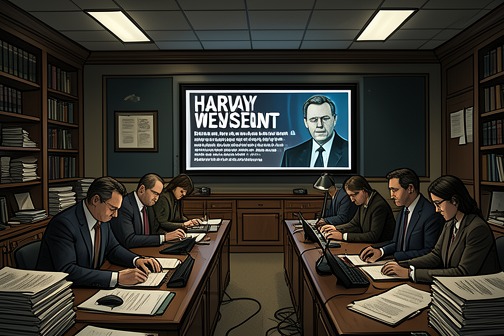
[The New York Times](entity:organization-recall-organization-the-new-york-tim-bb503dc75ff2)’ investigation into [Harvey Weinstein](entity:character-recall-character-harvey-weinstein-f7123ea4807b)’s sexual harassment brought allegations against a powerful film producer into public view and exposed a larger question: how misconduct could persist when secrecy, workplace power, and private settlements made it difficult to confront. Its publication in October 2017 became a catalyst for further reporting and for women speaking publicly about experiences across industries and countries.
## Origins and reporting approach
The project took shape in the wake of the reporting on Bill O’Reilly and [Fox News](entity:organization-recall-organization-fox-news-fdbd25aba29e). That earlier work had shown how settlements and their financial and legal trails could reveal a story rather than bury it. As women reacted to the disclosures about O’Reilly, editors at The New York Times saw a rare opportunity to ask more people to speak on the record. The reporting also suggested a method: look for patterns of behavior and the arrangements that kept them hidden, rather than treating each allegation as an isolated case.
[Rebecca Corbett](entity:character-recall-character-rebecca-corbett-4fd0a83fce5e) asked [Jodi Kantor](entity:character-recall-character-jodi-kantor-0151139c3346) to pursue two connected questions: whether other powerful men were concealing abusive behavior toward women, and what systems made sexual harassment so pervasive and difficult to address. After receiving advice to look toward [Hollywood](entity:location-recall-location-hollywood-3ce8b1af5069), Kantor and [Megan Twohey](entity:character-recall-character-megan-twohey-bcae6f5603e3) discussed how to approach women who might be reluctant to talk. Twohey drew on her earlier work with rape victims, emphasizing that a person’s account might help protect others. The appeal offered a reason to speak without promising that publicity would be easy or that the past could be changed.
The inquiry was therefore not limited to identifying an individual wrongdoer. Its wider frame considered how settlements could mask repeated misconduct and how institutional practices affected the possibility of reporting it. The investigation’s significance lay both in the allegations it brought forward and in its attention to the conditions that had allowed them to remain difficult to see.
## Publication and its immediate effects
The Weinstein story helped make the subject of workplace sexual harassment newly visible. In the weeks after the first article, The New York Times and other news organizations received an overwhelming flow of tips from women in the United States and beyond. The accounts were not yet a verified record simply by arriving; they formed a large, urgent body of leads that journalists across news organizations began investigating.
The investigation also changed the terms in which the public could understand the allegations. Harvey Weinstein’s name became a cautionary example of what could happen when misconduct went unchecked for years, and of how behavior previously minimized could be understood as part of a more serious pattern. A growing public consensus treated speaking about harassment and abuse as admirable rather than shameful or disloyal, while employers faced a new warning that tolerating such conduct could carry serious consequences.
The work expanded beyond Hollywood. The Times’ sexual-harassment team investigated accounts from restaurant workers, ballet dancers, domestic and factory workers, Google employees, models, prison guards, and others. In a separate investigation, Jodi Kantor and two colleagues documented accounts from five women about Louis C.K.; within less than a month, he lost the distribution of a forthcoming film, the backing of his television network, and the support of his agency, manager, and publicist. That rapid sequence illustrated how reporting could connect testimony with professional accountability.
## A wider wave of response
In autumn 2017, women from many walks of life shared #[MeToo](entity:expression-recall-expression-metoo-6aff81e06a5a) accounts on social media, often without the months of trust-building and persuasion required in the Weinstein investigation. Megan Twohey, taking a break from work one night, saw posts from women she knew and wept. The change was not only in the volume of accounts but in the confidence that speaking might produce action.
As more women came forward, businesses and other institutions investigated and dismissed leaders. Those consequences strengthened the expectation that telling the truth could matter, encouraging further disclosures. The resulting public scrutiny reached well beyond individual cases: practices such as sexual overtures from a boss, mandatory arbitration policies that kept harassment claims secret, and conduct treated as trivial in everyday settings all came under renewed question. The reporting did not by itself account for every part of this movement, but it helped make a wider examination possible.
## The longer aftermath
The effects continued into the following years and took different forms for the women whose accounts had entered the reporting. [Ashley Judd](entity:character-recall-character-ashley-judd-80d355bd4049) received public praise and awards, accepted a future teaching post at [Harvard Kennedy School](entity:location-recall-location-a6b80863f69e), joined the board of Time’s Up, and filed a lawsuit against Harvey Weinstein alleging harassment, defamation, and lost career opportunities. [Laura Madden](entity:character-recall-character-laura-madden-b39780ff050b), a former [Miramax](entity:organization-recall-organization-miramax-388ab8c00c74) assistant who had spoken about being harassed in [Dublin](entity:location-recall-location-d7ee455b2147) decades earlier, remained soft-spoken even as she met other participants in person.
[Zelda Perkins](entity:character-recall-character-zelda-perkins-86704e1b4631), another former Miramax employee, had publicly broken her settlement nondisclosure agreement after the story appeared, while withholding details that would identify the colleague she had sought to protect, [Rowena Chiu](entity:character-recall-character-rowena-chiu-cd5672993973). Perkins went on to challenge confidential settlements in the media and in the British Parliament. Chiu, who had not yet spoken publicly, later described the particular difficulty of deciding whether to tell her account: she worried about the disruption to her life and about the scarcity of Asian voices speaking about such experiences. Her hesitation made plain that public attention did not remove the personal and cultural costs of disclosure.
On January 16, 2019, twelve women who had been part of the reporting met in [Los Angeles](entity:location-recall-location-los-angeles-11eff639bdf5) at the journalists’ request. The gathering revisited a question the reporters had considered during the investigation: what happened to women after they spoke up? Its participants differed sharply in public recognition and economic security. [Kim Lawson](entity:character-recall-character-kim-lawson-1fdf55cb4fc6), a McDonald’s worker who had been homeless six months earlier and was then earning $10 an hour, sat in the same room as women from film and public life. Lawson described filing a complaint with the [Equal Employment Opportunity Commission](entity:organization-recall-organization-equal-employment-06a2825c8ffb) and joining a September strike; she had spoken publicly, given interviews, and pushed her daughter in a stroller during the march. Perkins spoke of her activism against confidentiality agreements. Their accounts showed that speaking out could bring new authority and solidarity, while leaving the material and personal differences among women unmistakable.
Event 29
McDonald’s workers’ anti-sexual-harassment walkout

[McDonald’s workers’ anti-sexual-harassment walkout](entity:event-recall-event-88737f5213fd) was a coast-to-coast protest against the company’s weak policies, bringing workplace complaints into public view through collective action. [Kim Lawson](entity:character-recall-character-kim-lawson-1fdf55cb4fc6), a McDonald’s worker who had filed a complaint with the [Equal Employment Opportunity Commission](entity:organization-recall-organization-equal-employment-06a2825c8ffb), took an active role in the protest. The walkout made visible both the force of solidarity and the distance between public commitments to reform and conditions workers could yet see change.
## Background and Stakes
The walkout challenged a workplace policy the book describes as weak. Lawson’s own circumstances sharpened the stakes: she was earning $10 an hour, and six months before the gathering where she later recounted the protest, she had been homeless. Her participation connected the demand for protection from harassment to the material vulnerability of a low-paid worker, rather than treating reform as an abstract corporate promise.
The protest also belonged to a wider period of public action over harassment. As the confirmation of [Brett Kavanaugh](entity:character-recall-character-brett-kavanaugh-bfffdaaead20) was being debated, McDonald’s employees were taking their complaint directly into the streets. The account identifies the walkout as coast-to-coast and reports that historians were calling it the country’s first strike related to sexual harassment in a century.
## The Walkout and Lawson’s Role
Lawson described the September action as loud and energetic, marked by chanting, solidarity, and encounters with new people. Men also turned out in support and deliberately marched behind the women. The protest made support visible in the procession itself: workers were not isolated voices addressing management one by one, but part of a public group with others walking alongside them.
Lawson filed a complaint against McDonald’s with the Equal Employment Opportunity Commission, the federal agency responsible for enforcing workers’ rights against discrimination. She also delivered a speech and gave interviews during the protest. She pushed her daughter along the length of the march in a stroller, carrying family responsibility into the same public space where she was asserting her rights as a worker.
## Solidarity and New Authority
The walkout gave Lawson a sense of agency she had not experienced before. In her account, the march’s chants and the presence of supporters helped turn speaking out from an individual risk into a shared act. Her public role continued beyond the day of protest: she became a kind of team coach to McDonald’s women involved in the union effort, counseling them through a text chain.
That shift also changed how other people saw her. Customers recognized Lawson from television coverage of sexual harassment. The account presents this recognition as part of a reversal: a worker who had faced harassment became a visible source of guidance and authority for other employees. Her activism did not erase the economic precarity reflected in her wages and recent homelessness, but it gave her a platform from which to help organize others.
## Reforms and Their Limits
After the walkout, McDonald’s began strengthening its policies. The company introduced new training for managers, established a hotline, and planned posters explaining how employees could report harassment. These measures indicated an institutional response, but the account distinguishes announced changes from changes workers had actually experienced: Lawson had not yet seen the new measures materialize in her own store.
The outcome therefore remained unsettled. The protest had assembled workers across the country and helped make harassment a subject of collective workplace action, while the practical reach of the company’s reforms remained unclear across its thousands of locations. Its significance lies in that tension: workers made their demands public, and the company began to respond, but a walkout and a set of announced policies could not by themselves establish whether conditions would change on the ground.
Event 30
Bill Cosby’s sentencing
[Bill Cosby’s sentencing](entity:event-recall-event-fe1441eabce7) to three to ten years in prison became a public marker of accountability during the #[MeToo era](entity:time-recall-time-metoo-era-083b81cbaef2). In the account, its significance is carried both by the sentence itself and by [Debra Katz](entity:character-recall-character-debra-katz-f91a9e8c2975)’s reaction to a newspaper headline: after years in which many thought such an outcome would never come, she felt that history was on her side.
## Background and setting
The sentencing had taken place the day before Debra Katz and [Lisa Banks](entity:character-recall-character-lisa-banks-f928ab535f1c) returned to their preparations for [Christine Blasey Ford](entity:character-recall-character-christine-blasey-fo-12fef896cc08)’s testimony. [Jodi Kantor](entity:character-recall-character-jodi-kantor-0151139c3346) was brought upstairs to witness the final stretch of that work. The lawyers’ office had become a command center: security guards stood at the door after threats, while flowers sent to Ford by strangers filled Katz’s desk and stacks of cookies crowded the file cabinets. The remaining team, mostly women volunteering to help Ford, was energized, optimistic, and defiant.
## The sentence and its public meaning
On the way to the elevator, Katz picked up a print copy of [The New York Times](entity:organization-recall-organization-the-new-york-tim-bb503dc75ff2) and gestured triumphantly at the headline, “Bill Cosby, Once a Model of Fatherhood, Is an Inmate.” Cosby had been sentenced to three to ten years in prison. The sentence mattered in the scene not merely as a legal outcome but as a result that had once seemed improbable: the account notes that many had thought accountability would never arrive. Commentators were calling it the first major verdict of the #MeToo era, and Katz took that judgment as evidence that the historical moment might be moving in Ford’s favor.
## Contrast and narrative significance
That confidence sits beside a sharply different public response. At the same time, [Donald Trump](entity:character-recall-character-donald-trump-7f2fc1beaa4a) was on television denouncing the accusations against [Brett Kavanaugh](entity:character-recall-character-brett-kavanaugh-bfffdaaead20) as a Democratic “con job” and describing himself as the target of false charges. Trump also attacked reporting by [Megan Twohey](entity:character-recall-character-megan-twohey-bcae6f5603e3) and Michael Barbaro as “false reporting” and “fake news.” The juxtaposition does not erase the force of Cosby’s sentence; it shows that a prominent verdict could signal accountability while powerful figures continued to contest the credibility of allegations and reporting. In the Ford preparations, the headline thus functioned as a sign of possibility, not proof that the struggle was settled.
Event 31
Les Moonves’s resignation as CBS chairman
[Les Moonves’s resignation as CBS chairman](entity:event-recall-event-cbs-65278db391e5) marks a shift in the book’s account of the #[MeToo](entity:expression-recall-expression-metoo-6aff81e06a5a) reckoning from public debate and protest to consequences at the highest levels of corporate leadership. The book identifies Moonves as the first Fortune 500 chief executive to lose his job in that reckoning, while placing his departure among other developments that showed the movement reaching across workplaces and institutions.
## Place in the 2018 reckoning
The resignation appears amid the conflict over [Christine Blasey Ford](entity:character-recall-character-christine-blasey-fo-12fef896cc08)’s allegations against [Brett Kavanaugh](entity:character-recall-character-brett-kavanaugh-bfffdaaead20) and the response to them. Rather than treating Moonves’s departure as an isolated corporate story, the narrative groups it with events unfolding across the country: McDonald’s workers held a coast-to-coast walkout over the company’s sexual-harassment policies, and activists working to end sexual violence were recognized with the Nobel Peace Prize. The sequence conveys the range of the moment, from worker organizing to consequences for a prominent executive.
## A corporate consequence
The account gives one decisive fact about Moonves’s departure: he stepped down as [CBS](entity:organization-recall-organization-cbs-e52486a582c7) chairman and became the first Fortune 500 CEO to lose his job in the #MeToo reckoning. It does not detail the allegations or circumstances behind his resignation, so the significance established here is institutional rather than biographical. His exit stands as evidence that the broader public confrontation with sexual misconduct could carry consequences into executive leadership.
## A movement with multiple fronts
The book places the resignation alongside developments that were still unfolding. At the time, [The New York Times](entity:organization-recall-organization-the-new-york-tim-bb503dc75ff2) was finishing a report about secret problems involving senior male executives at Google, including an executive paid $90 million to leave after another employee accused him of forced oral sex; he denied the allegation. The juxtaposition does not establish that these events caused Moonves’s departure. Instead, it shows how the narrative frames the reckoning as a widening examination of workplace power, corporate responses, and the treatment of people who reported misconduct.
## Public change and its limits
The broader account resists measuring the movement’s fate by any single event. The book notes that Kavanaugh’s confirmation did not settle the question of #MeToo’s future: workers were organizing, a high-profile executive had lost his position, and public debate was prompting quieter reassessments of behavior. Moonves’s resignation is therefore a concrete marker of institutional accountability within a larger and unfinished social change, not a resolution of the tensions surrounding it.
Event 32
Publication of the New York Times investigation into Harvey Weinstein
The publication of [The New York Times](entity:organization-recall-organization-the-new-york-tim-bb503dc75ff2) investigation into [Harvey Weinstein](entity:character-recall-character-harvey-weinstein-f7123ea4807b) turned years of largely hidden allegations into a public reckoning. The reporting connected women’s accounts to a broader system in which settlements and confidentiality clauses could conceal claims, leaving future employees and the public without access to information about repeated conduct. Its effect extended beyond the article: women who had spoken privately or under restriction began to consider what public disclosure might make possible.
## From individual allegations to a system
The investigation took shape against a growing recognition among reporters that tools meant to address workplace sexual harassment could also help suppress it. In examining settlements in other high-profile cases, journalists encountered agreements that required women to surrender evidence, restricted them from assisting others with similar claims, and could oblige them to notify the accused person’s team if they were subpoenaed. In one case, a lawyer agreed to advise the accused on sexual-harassment matters. The clauses were not presented as isolated curiosities; attorneys described such provisions as standard practice.
Those agreements offered women money, privacy, and a way to leave a punishing dispute behind. But the choices were shaped by limited alternatives: federal protections excluded some workers, filing deadlines could be short, and damages were capped. Contingency fees also gave lawyers a financial reason to favor settlements over litigation. The result was a system that could compensate an individual while keeping information about alleged behavior from reaching other workers or the public.
## The evidence of enforced silence
The reporting’s larger argument became concrete in the restrictions attached to former [Miramax](entity:organization-recall-organization-miramax-388ab8c00c74) assistant [Zelda Perkins](entity:character-recall-character-zelda-perkins-86704e1b4631)’s settlement. When she showed [Jodi Kantor](entity:character-recall-character-jodi-kantor-0151139c3346) fragments of the paperwork, the agreement barred her from discussing her time at Miramax, restricted what she could say to medical professionals and her accountant, and required her to account for people she had already told about events in [Venice](entity:location-recall-location-venice-0377938b8d6a). It also barred contact with existing or future media. If the matter became public, she could be required to help contain further disclosure.
The limits reached beyond what Perkins could say: she had not been allowed to keep a complete copy of the agreement, and she could consult the paperwork only at her lawyer’s office. Perkins and [Rowena Chiu](entity:character-recall-character-rowena-chiu-cd5672993973), who had a matching agreement, had accepted confidentiality terms under pressure from Weinstein’s lawyers. Their experience showed how an agreement could shape life long after a settlement, while making the underlying account difficult to verify or share. The investigation’s significance lay in treating such restrictions not as private legal details but as part of the story.
## Publication and the consequences of speaking
The article’s publication brought allegations against Weinstein into public view and prompted additional women to come forward. The book’s account traces the investigation’s impact beyond the initial reporting to a second article and to the growing number of women willing to speak. What had been difficult to see as a pattern while accounts remained separated by settlements became more legible when the reporting assembled them for readers.
The change did not make the costs of disclosure disappear. At a later gathering of women whose experiences had been reported, participants came from markedly different circumstances: [Kim Lawson](entity:character-recall-character-kim-lawson-1fdf55cb4fc6) had recently been homeless and was earning ten dollars an hour at McDonald’s, while [Gwyneth Paltrow](entity:character-recall-character-gwyneth-paltrow-5bbcd59dc543)’s home made the differences in wealth and security among the women tangible. [Ashley Judd](entity:character-recall-character-ashley-judd-80d355bd4049) was toasted for having spoken on the record in the first Weinstein story, before others followed. Their varied positions shaped what speaking out could cost and what resources were available afterward.
## A widening circle of voices
For Rowena Chiu, the gathering marked a further decision point rather than a completed public disclosure. She said she was the only woman at the table who had not yet gone public with her story, and that, apart from her husband, her family still knew nothing. She also described how the expectation that Asian Americans should avoid making a fuss could weigh on the choice to speak. The article’s aftermath therefore included not only people already telling their stories but people assessing, in the presence of others, whether they could begin.
The gathering also brought together forms of action that did not look alike. Lawson described filing a complaint with the [Equal Employment Opportunity Commission](entity:organization-recall-organization-equal-employment-06a2825c8ffb) and joining a September strike, where she spoke, gave interviews, and pushed her daughter in a stroller. She had become a source of guidance to other McDonald’s workers organizing through a text chain. Perkins, meanwhile, recalled testifying about confidentiality agreements to members of Parliament. The investigation’s reach is visible in this contrast: disclosure could lead to public testimony, workplace organizing, or a still-unresolved decision to speak. Its publication exposed a system of silence, while the women’s subsequent actions showed how that silence could be challenged in different ways.
Event 33
The widespread rise of the 2017 #MeToo movement
The widespread rise of the 2017 #[MeToo movement](entity:concept-recall-concept-metoo-9aa194a9f9fc) made individual accounts of sexual harassment and abuse part of a much larger public reckoning. It grew alongside investigative reporting, but was not confined to it: women increasingly shared their experiences on social media of their own accord, while public complaints, collective action, and institutional responses made speaking out seem more consequential. The movement’s reach exposed both the common structures behind misconduct and the unequal costs of challenging them.
## From a reporting opening to a wider project
The publication of reporting about [Bill O'Reilly](entity:character-recall-character-bill-o-reilly-f48f512c9b27) and [Fox News](entity:organization-recall-organization-fox-news-fdbd25aba29e) gave editors at [The New York Times](entity:organization-recall-organization-the-new-york-tim-bb503dc75ff2) reason to think public attention might create a rare opening for women to speak candidly. Women were already expressing frustration over revelations about O'Reilly, as they had after [Donald Trump](entity:character-recall-character-donald-trump-7f2fc1beaa4a)’s comments about women. Yet coming forward remained difficult. The reporting team treated the moment as an opportunity, not a guarantee: few sources volunteered their accounts without encouragement and sustained contact.
That experience helped shape the paper’s subsequent work. [Rebecca Corbett](entity:character-recall-character-rebecca-corbett-4fd0a83fce5e) asked [Jodi Kantor](entity:character-recall-character-jodi-kantor-0151139c3346) to investigate whether powerful men beyond O'Reilly were accused of concealing abusive behavior, and to examine the systems that made harassment so pervasive and difficult to address. [Megan Twohey](entity:character-recall-character-megan-twohey-bcae6f5603e3) and Kantor discussed how to approach potential sources, including the possibility that sharing an experience might help protect other people. The appeal was not that disclosure would undo what had happened; it was that an account could have consequences beyond the person who told it.
The investigation widened beyond individual allegations to workplaces with different forms of power and vulnerability. Reporters examined technology companies, academia, and jobs held by low-income workers with little public visibility and limited recourse. Harassment took distinct forms across those settings: restaurant managers could be reluctant to confront customers, while women in traditionally male work sites described being placed in physical danger. The range mattered. It suggested that the problem could not be understood only through the conduct of a few prominent men, or through the experiences of women with the greatest public standing.
## From investigation to collective speech
In the weeks after The New York Times published its first Weinstein story in October 2017, tips surged into news organizations in the United States and beyond. The accounts were numerous, painful, and initially unvetted; the resulting investigations became a project across journalism. The Times’ reporting expanded to include restaurant waitstaff, ballet dancers, domestic and factory workers, Google employees, models, and prison guards, among others. Accounts of misconduct by Louis C.K. were documented within less than a month, followed by the loss of his film’s distribution, television-network backing, and professional representatives.
That autumn, women also began posting #[MeToo](entity:expression-recall-expression-metoo-6aff81e06a5a) stories on social media in a notably different way from the sources in the Weinstein investigation. They came forward in solidarity and on their own initiative, without the months of trust-building and persuasion that reporting had often required. Megan Twohey, reading posts from women she knew during a break from work, was moved by the sight of their declarations. The contrast marked a shift in the conditions of speaking: testimony was no longer only the result of a reporter’s approach but could become a public act that invited others to speak as well.
## Unequal risks, shared authority
The movement’s collective language did not erase differences in money, race, occupation, or public visibility. At a later gathering of women whose accounts had appeared in the reporting, the participants met as near-strangers, united by having weighed the risks of telling their stories. The interview took place at [Gwyneth Paltrow](entity:character-recall-character-gwyneth-paltrow-5bbcd59dc543)’s home, where the surroundings made economic disparities tangible. [Kim Lawson](entity:character-recall-character-kim-lawson-1fdf55cb4fc6), a McDonald’s worker who had been homeless six months earlier and was then earning ten dollars an hour, sat among participants whose circumstances were markedly different.
Lawson’s account showed how a complaint could become a route to public action. She had filed a complaint against McDonald’s with the [Equal Employment Opportunity Commission](entity:organization-recall-organization-equal-employment-06a2825c8ffb) and described taking part in a September strike, giving a speech, and pushing her daughter in a stroller along the march. Men joined in support, deliberately marching behind the women. Lawson had also become a source of advice for other McDonald’s employees involved in organizing, communicating with them through a text chain. The movement did not simply give her a platform; her experience fighting harassment gave her standing to encourage others.
[Zelda Perkins](entity:character-recall-character-zelda-perkins-86704e1b4631) and Lawson found an unexpected echo across their different lives. Perkins, a British producer who had been twenty-four when she left [Miramax](entity:organization-recall-organization-miramax-388ab8c00c74), recalled testifying to members of Parliament about confidentiality agreements and described the authority she felt in entering Westminster as an individual. Lawson described the power of filing a complaint and marching. Their stories traced a reversal: women who had faced harassment could gain respect and influence through opposition to it.
The same gathering also showed that solidarity did not make disclosure easy or inevitable. [Rowena Chiu](entity:character-recall-character-rowena-chiu-cd5672993973) said she had not yet made her story public and that, apart from her husband, her family did not know about it. She connected her hesitation to the scarcity of Asian women’s public accounts and to a model-minority expectation that Asian Americans keep their heads down and avoid making trouble. Hearing the others helped her consider speaking, but she described the prospect as frightening and potentially life-altering. The movement created a setting in which disclosure could be imagined; it did not remove the personal and cultural pressures that constrained it.
## Accountability and the continuing reckoning
The movement’s force depended in part on a developing expectation that telling the truth could lead to action. Businesses and other institutions investigated and fired leaders; those consequences encouraged further disclosures. Public attention also reached beyond individual employment cases, contributing to protests and resignations in different countries and putting previously tolerated practices under scrutiny. Mandatory arbitration that concealed harassment, unwelcome overtures from a boss, and everyday behavior that normalized women’s mistreatment all became subjects of renewed challenge.
The Weinstein story came to represent more than allegations against one powerful employer: it became an argument against allowing misconduct to go unchecked for decades, and a warning that behavior treated as less serious could precede more serious harm. The broadening of public speech changed the meaning attached to disclosure. Speaking about harassment could be seen as admirable rather than shameful or disloyal, while employers faced greater risk in ignoring complaints. The movement’s significance lay in that feedback between testimony and consequence: as more women believed their accounts might prompt action, more were willing to tell them, making the scale of the problem harder to dismiss.
Event 34
The Access Hollywood tape controversy

[The Access Hollywood tape controversy](entity:event-recall-event-access-hollywood-26ae7e85755c) is presented as part of the pre-2016-election allegations concerning [Donald Trump](entity:character-recall-character-donald-trump-7f2fc1beaa4a). The book’s references connect the tape’s comments to allegations of sexual aggression and return to the controversy in connection with a presidential debate; the evidence available here does not provide a fuller account of the recording or the debate discussion.
## Place in the Election Controversy
The book’s index groups references to the Access [Hollywood](entity:location-recall-location-hollywood-3ce8b1af5069) comments with its coverage of allegations of sexual aggression by Trump. Its broader framing identifies the tape’s release as part of the pre-election controversy, placing it in the political context of the [2016 United States presidential election](entity:time-recall-time-2016-united-states-presi-634cf4f87111). The supplied passages do not establish further specifics about when or how the recording was made or released.
## Debate and Recurrence
A separate index entry links the subject to a presidential debate, indicating that the controversy reappears in that political setting. Other index references spread across the book point to recurring attention to the tape rather than a single isolated mention. The evidence does not detail what was said about it during the debate or specify the responses it drew.
## Limits of the Account
The evidence supports the controversy’s association with Trump, allegations of sexual aggression, the pre-election period, and a presidential debate. It does not support a more granular reconstruction of the tape’s contents, its immediate public reception, or its political consequences; those details are therefore not supplied here.
Event 35
The 2017 Women’s March
[The 2017 Women’s March](entity:event-recall-event-2017-fecd70a704d0) is part of the book’s account of a period when women’s collective action and public speech were becoming harder to ignore. The book lists women’s marches among its recurring points of reference, but does not develop the event as a standalone scene; its significance here lies in the broader climate of mobilization around the reporting, protest, and public disclosures of 2017.
## Place in the wider mobilization
The reporting on Bill O’Reilly’s conduct helped shape the editorial moment in which [Jodi Kantor](entity:character-recall-character-jodi-kantor-0151139c3346) and [Megan Twohey](entity:character-recall-character-megan-twohey-bcae6f5603e3) pursued a broader investigation. After O’Reilly was fired, [Rebecca Corbett](entity:character-recall-character-rebecca-corbett-4fd0a83fce5e) asked Kantor to examine both whether powerful men elsewhere were concealing abusive behavior and what systems made harassment so pervasive and difficult to address. The reporting approach therefore joined individual accounts to questions about settlements, institutional practices, and the silences surrounding them.
The book describes that work as occurring when women seemed increasingly ready to express their frustration publicly. For journalists, the moment presented an opportunity to invite candor, but speaking to a reporter about painful experiences remained difficult. Twohey proposed framing the request around helping protect other people, an appeal that gave potential sources a reason to take the risk without promising that disclosure would undo what had happened. The contrast between painstaking efforts to build trust with sources and the later visibility of collective public speech is central to the book’s account of how mobilization grew.
## From disclosure to accountability
After the first Weinstein article appeared in October 2017, tips poured into [The New York Times](entity:organization-recall-organization-the-new-york-tim-bb503dc75ff2) and other news organizations. The book describes the ensuing work as a wide-ranging journalistic project, extending from restaurant workers and domestic and factory workers to ballet dancers, prison guards, models, and employees in technology. That expansion made public disclosure more than a sequence of stories about prominent individuals: it exposed experiences across workplaces and levels of visibility.
That autumn, women also posted #[MeToo](entity:expression-recall-expression-metoo-6aff81e06a5a) accounts on social media, often coming forward without the months of persuasion and relationship-building required in the Weinstein investigation. Megan Twohey, reading posts from women she knew, was moved to tears. The book links the growing volume of testimony to a developing sense of accountability: when women believed that telling their stories could lead to action, more spoke, and institutions investigated and dismissed leaders. Those consequences, in turn, encouraged further disclosure. The Women’s March belongs to this broader setting of collective expression, though the account does not claim that the march itself caused these developments.
## Protest and unequal routes to public voice
The book’s account of action beyond the marches makes clear that collective protest took different forms. [Kim Lawson](entity:character-recall-character-kim-lawson-1fdf55cb4fc6) described filing a complaint against McDonald’s with the [Equal Employment Opportunity Commission](entity:organization-recall-organization-equal-employment-06a2825c8ffb) and joining a September strike. She recalled chanting, solidarity, new relationships, and men deliberately marching behind the women. She also spoke of giving interviews and pushing her daughter in a stroller along the march. This workplace protest is distinct from the 2017 Women’s March, but it illustrates how the book connects public action to efforts to challenge harassment and gain recognition at work.
The women’s experiences were not interchangeable. At the later gathering hosted by [Gwyneth Paltrow](entity:character-recall-character-gwyneth-paltrow-5bbcd59dc543), Lawson was earning $10 an hour and had been homeless six months earlier; the setting of Paltrow’s home made the difference in their circumstances visible. [Rowena Chiu](entity:character-recall-character-rowena-chiu-cd5672993973), meanwhile, said she had not yet made her story public and that even her family, apart from her husband, did not know it. She reflected on the pressures on Asian women not to make a fuss or cause waves, and on the fear that disclosure could shock friends and change her life. The book’s portrait of collective action thus includes both the possibility of solidarity and the unequal risks that shape who can speak, when, and at what cost.
Event 36
2016 U.S. Presidential Election That Elected Trump
The [2016 U.S. Presidential Election That Elected Trump](entity:event-recall-event-2016-334b7cb328d6) placed [Megan Twohey](entity:character-recall-character-megan-twohey-bcae6f5603e3)’s reporting on [Donald Trump](entity:character-recall-character-donald-trump-7f2fc1beaa4a)’s alleged conduct against a public choice whose outcome few at the time expected. On November 7, Megan traveled to polling places in Park Ridge, Illinois, a suburb of Chicago and Hillary Clinton’s hometown, to capture what many believed would be the election of the first woman president. She was not there to advocate for a candidate. Instead, the day became a revealing measure of how little the allegations that had shaped her reporting appeared to matter to many voters, even as women were beginning to speak publicly about mistreatment by powerful men.
## The campaign and the reporting
The book situates the election within a contradiction: women had entered professions and positions of authority once largely closed to them, yet sexual harassment remained routine in many workplaces, and those who spoke up were often dismissed or isolated. Men accused of misconduct could continue to accumulate success and public praise. Megan had reported on women who alleged that Trump preyed on them, then had to cover his rise to the presidency. The election therefore followed a campaign in which allegations about a candidate’s treatment of women were already part of the public record, but did not determine how many voters chose.
In May 2016, Megan and a colleague published a New York Times investigation in which women described alleged misconduct by Trump in their own words. The article included Trump’s denials and his insistence that he had treated women with respect. Its reporting also illustrates the verification that preceded publication: Megan assembled allegations beyond one highly publicized claim, while the team excluded another woman’s account after a colleague could not confirm a key detail with her father. The article became the Times’ most-read political article of that year up to that point. Its reception showed that the allegations could command broad attention, but attention was not the same as electoral consequence.
## Megan at the polling place
The editors sent Megan to Park Ridge partly for the symbolism of the possible historic result. Her earlier reporting had also examined Hillary Clinton’s role in responding to women who accused Bill Clinton of sexual impropriety. Although Clinton’s allies argued that her role had been limited, Megan found evidence that she had approved hiring a private detective to seek damaging information about the women. By including this reporting, the book presents Megan’s election coverage as independent of either campaign: she was not expected to shield the Democratic nominee while scrutinizing Trump.
Megan expected to encounter concern about Trump’s alleged conduct and his recorded remarks on the [Access Hollywood tape](entity:object-recall-object-access-hollywood-tape-3bec522d1a67). In interviews with voters, however, very few of the suburban white women she spoke with appeared to care much about either. The disparity between her expectation and what she heard was consequential: the allegations had been reported, discussed, and amplified, yet they did not seem to carry the weight she anticipated among these voters. That observation is limited to the people she interviewed at the polling place; it does not establish what all women, or the electorate as a whole, thought.
That night, Megan already knew Trump had been elected. The outcome overturned the expectation of a first woman president and made the election a personal reporting moment as well as a national result. The book does not claim that voters’ responses to the allegations alone explain the outcome. Rather, it records the gap between a growing public conversation about women’s experiences and the apparent indifference Megan encountered in one setting. In the weeks before the election, women had used #[WhyWomenDontReport](entity:expression-recall-expression-whywomendontreport-128d30f16b9b) to describe similar experiences with other men. [Rose McGowan](entity:character-recall-character-rose-mcgowan-ff89b5d83c63) was among those speaking online about a studio head who had violated her. These accounts formed a rising chorus, but their visibility did not prevent Trump’s victory.
## From electoral outcome to investigative opening
The book places the election in a longer sequence rather than treating it as the cause of the later Weinstein investigation. After Trump’s victory, Megan and [Jodi Kantor](entity:character-recall-character-jodi-kantor-0151139c3346) watched a series of developments that changed how newsrooms approached workplace harassment. In April 2017, [The New York Times](entity:organization-recall-organization-the-new-york-tim-bb503dc75ff2) exposed settlements involving Bill O’Reilly and [Fox News](entity:organization-recall-organization-fox-news-fdbd25aba29e). The reporting showed how lawyers, negotiations, and payments could leave a trace even when agreements were intended to keep allegations quiet. Advertisers withdrew, other women at Fox complained, and O’Reilly was fired. The institution’s response to public exposure, rather than the claims being entirely unknown beforehand, became part of the story.
Times editors saw the O’Reilly reporting as a possible model for investigating other powerful men and the systems that concealed harassment. [Rebecca Corbett](entity:character-recall-character-rebecca-corbett-4fd0a83fce5e) asked Jodi to examine both individual perpetrators and the broader role of settlements. When Jodi sought advice, Megan discussed why women such as Jessica Leeds and [Rachel Crooks](entity:character-recall-character-rachel-crooks-b4fe9b2b087a) had come forward and how careful first conversations with potential sources could make the risk of speaking feel purposeful. The pitch she suggested centered on the possibility that sharing an experience might help protect others. That reporting approach helped shape the work that led to the investigation of [Harvey Weinstein](entity:character-recall-character-harvey-weinstein-f7123ea4807b); it did not arise from the election alone.
## Significance and limits
The election’s significance in the book lies in its contrast between exposure and accountability. Megan had helped bring allegations about Trump into public view, and women were speaking online about comparable experiences, but the reporting did not produce the political result she had expected many voters to weigh. The account resists a simple story in which public speech immediately changes power. A campaign can make allegations visible without making them decisive to voters, while later journalism may build on earlier reporting methods, accumulated sources, and sustained feminist and legal advocacy.
The subsequent Weinstein reporting and the wider #[MeToo](entity:expression-recall-expression-metoo-6aff81e06a5a) wave are presented as the result of several forces converging over time, including the work of activists such as [Anita Hill](entity:character-recall-character-anita-hill-42bfdbbc271f) and [Tarana Burke](entity:character-recall-character-tarana-burke-0e7032605f74) and journalists beyond Megan and Jodi. The election thus marks neither the beginning nor the end of that broader reckoning. It is a point of contrast: a highly visible set of allegations coexisted with a decisive electoral outcome, while the later investigations showed how documented patterns, public testimony, and institutional scrutiny could create different forms of consequence.
Event 37
Anita Hill’s allegations at Clarence Thomas’s nomination hearings
[Anita Hill](entity:character-recall-character-anita-hill-42bfdbbc271f)’s allegations at Clarence Thomas’s 1991 [Supreme Court](entity:organization-recall-organization-5e343c624293) nomination hearings function in the book as a familiar precedent for later debates about sexual harassment and public accountability. Their significance lies in that recalled history: the controversy was already part of the reporters’ shared frame of reference as they investigated harassment across workplaces and institutions.
## A Known Precedent
In a discussion of what the journalists brought to their reporting, the book notes that the reporters knew the stories of Clarence Thomas and Bill Clinton. Its index separately identifies Hill and Thomas in connection with the nomination hearings, placing the allegations within the book’s account of the public history of sexual harassment. The event is therefore evoked as a recognized national controversy, not introduced as an isolated or newly discovered subject.
## From Public Controversy to Workplace Systems
The reporting project widened its focus beyond individual allegations. As journalists compared accounts from different industries, they began to see that practices intended to combat harassment could also help it persist. Workplace law treated harassment as a civil-rights violation, while settlements and confidentiality clauses could keep accounts from becoming public. In this larger frame, the Hill-Thomas controversy marks an earlier point at which allegations about sexual conduct and power reached the center of a Supreme Court nomination debate; the later investigation examines how organizational practices could contain such complaints in less visible settings.
## A Broader Field of Experience
The book sets this history against accounts from workers in restaurants, technology, construction, and other fields, where the conditions and risks differed. It also describes a later gathering that brought together women whose experiences came from worlds including entertainment, low-wage work, and Supreme Court confirmation politics. Those contexts should not be collapsed into Hill’s case: their juxtaposition instead underscores the range of settings in which women confronted barriers to speaking publicly. Hill’s allegations remain part of the political and cultural backdrop against which the book traces those differing routes to public testimony.
Event 38
Bill Cosby's 2018 Sentencing and Prison Term

Bill Cosby’s 2018 Sentencing and Prison Term is recorded in the book as a public legal outcome: a September 25, 2018, news report states that Cosby was sentenced to prison. The account identifies the result and its date without detailing the proceedings that led to it.
## The Recorded Sentence
The cited article by Graham Bowley and Joe Coscarelli is titled *Bill Cosby, Once a Model of Fatherhood, Sentenced to Prison*. Its headline places the sentence against a former public image of Cosby as a model of fatherhood, but the evidence supplied here does not describe how that image was formed or how the case proceeded. It establishes only that he was sentenced to prison and that the report appeared on September 25, 2018.
## Recurrence in the Book
The book’s index lists Cosby at pages 30, 61, 110, 113, and 231, indicating that he is mentioned at multiple points. Those references do not, by themselves, establish further details about the sentence. In this account, the sentencing remains a concise, dated fact rather than a narrated courtroom episode.
Event 39
McDonald’s employees’ #MeToo protest
The book records a nationwide protest by McDonald’s workers on September 18, 2018, as part of the wider #[MeToo](entity:expression-recall-expression-metoo-6aff81e06a5a) response to workplace harassment. Its significance in the narrative is the shift from individual accounts and high-profile investigations to collective action by workers in another sector. The available account establishes the protest’s date and national scope, but does not describe its locations, size, specific demands, or immediate results.
## Background
The protest appears in a book that traces harassment across industries rather than treating it as a problem confined to [Hollywood](entity:location-recall-location-hollywood-3ce8b1af5069). Its reporters describe how working conditions and power dynamics vary by sector, while noting that workplace sexual harassment falls under federal civil-rights protections. The book also examines how confidentiality provisions in settlements can keep allegations from public view. These wider discussions establish the context in which collective protest could matter, but the account does not identify any one of them as the direct cause of the McDonald’s action.
## The Protest
A contemporaneous newspaper reference identifies the action as protests staged by McDonald’s workers across the United States and dates its report to September 18, 2018. The book notes the event as a few weeks before its later discussion of other developments in the #MeToo period. It provides no further operational details, so the protest can be situated as a nationwide worker action, but not reconstructed as a specific march, walkout, or sequence of events.
## Place in the Wider Account
The book’s broader reporting emphasizes that harassment takes different forms in different workplaces. In restaurants generally, it notes the presence of alcohol and managers’ reluctance to confront customers who behave inappropriately; it does not state that these conditions characterized the McDonald’s protests or specify that they were the workers’ grievance. The distinction matters: the protest is recorded as part of the wider workplace conversation, while its particular aims remain unstated.
## Significance and Limits
By including workers at McDonald’s among the book’s references to harassment and #MeToo, the narrative marks collective action beyond the celebrity and executive settings that dominate its investigations. The event’s documented scope is striking, but the available evidence does not establish the number of participants, the response from the company, or any policy changes that followed. Its place in the account is therefore as a visible instance of workers acting together, rather than as a fully chronicled campaign or a documented turning point in company policy.
Event 40
Leslie Moonves’s resignation as CBS chief executive
[Leslie Moonves’s resignation as CBS chief executive](entity:event-recall-event-cbs-de612de51c25) is recorded as a departure that followed sexual-harassment claims. The book provides no further detail about the claims or the terms of his exit, so the event’s significance here lies in its place within a wider period of public scrutiny of workplace power and accountability.
## The Recorded Departure
A September 9, 2018, report described Moonves as stepping down from his role as [CBS](entity:organization-recall-organization-cbs-e52486a582c7) chief executive after sexual-harassment claims. The account establishes the sequence and the change in office, but does not specify the claims, Moonves’s response, or any further consequences. The resignation is therefore a clearly dated event whose immediate circumstances remain only briefly documented in the book’s references.
## A Wider Workplace Context
Elsewhere, the book argues that harassment takes different forms across industries: workplace drinking and managers’ reluctance to confront customers in restaurants, young men’s unchecked power in [Silicon Valley](entity:location-recall-location-silicon-valley-30b0e6e8fbcb), and physical danger used against women in traditionally male workplaces. It also observes that measures intended to address harassment can sometimes enable it. That discussion supplies a broader framework for understanding why departures following harassment claims mattered publicly, but it does not establish a direct connection between those specific workplace patterns and Moonves’s case.
## Speaking Out and Unequal Risks
The book also records women describing the different costs and possibilities of speaking publicly. At a gathering, the contrast between a low-paid McDonald’s worker who had recently experienced homelessness and the comforts of [Gwyneth Paltrow](entity:character-recall-character-gwyneth-paltrow-5bbcd59dc543)’s home made differences in economic circumstances visible. [Zelda Perkins](entity:character-recall-character-zelda-perkins-86704e1b4631) and [Kim Lawson](entity:character-recall-character-kim-lawson-1fdf55cb4fc6), from markedly different backgrounds, described turning their experiences into activism; Lawson spoke about filing a complaint with the [Equal Employment Opportunity Commission](entity:organization-recall-organization-equal-employment-06a2825c8ffb) and taking part in a strike. These accounts illuminate the broader environment in which workplace allegations became public, without identifying them as part of the events surrounding Moonves’s resignation.
## Place in the Narrative
The resignation functions as a concise chronological entry in the book’s account of a larger reckoning. Its spare documentation sets it apart from the extended personal accounts and workplace investigations elsewhere in the narrative: the record names the office, the departure, and the claims that preceded it, but leaves the particulars unelaborated. The event marks public consequence while preserving an important distinction between what the book establishes and what it does not describe.
Event 41
The 2018 Brett Kavanaugh Supreme Court confirmation hearing
[The 2018 Brett Kavanaugh Supreme Court confirmation hearing](entity:event-recall-event-2018-210a80a08a89) turned [Christine Blasey Ford](entity:character-recall-character-christine-blasey-fo-12fef896cc08)’s account of a high-school assault into testimony before the Senate Judiciary Committee, making the nomination a public contest over memory, evidence, and the treatment of an accusation. The hearing’s significance began before Ford entered the room: her account had been disclosed privately years earlier, while the lasting effects of the incident had shaped parts of her life long before it became a national political story.
## Before the hearing
In 2012, while Ford and her husband were in counseling over communication problems and lingering disputes about remodeling their [Palo Alto](entity:location-recall-location-palo-alto-1bc708d839dd) house, her insistence on building a second front door became a way into a difficult explanation. She said she needed another exit because, as a teenager, she had been trapped in a room and physically restrained by a boy who molested her while another boy watched. Her husband, Russell Ford, later stated in a sworn affidavit that she had named [Brett Kavanaugh](entity:character-recall-character-brett-kavanaugh-bfffdaaead20) as the attacker and described him as a successful lawyer from her hometown who was well known in [Washington, D.C.](entity:location-recall-location-washington-d-c-2a63ac520a1d)
Counseling helped Ford recognize the continuing effects she associated with the assault: confined spaces could bring on severe anxiety, and conflict could prompt an urge to flee. She later discussed the experience with other therapists, including a specialist in post-traumatic stress disorder, and with several friends. These earlier disclosures formed part of the context for the hearing, distinguishing Ford’s account from one first produced after Kavanaugh’s nomination, without themselves resolving the allegation.
Ford also mentioned the assault to her friend [Keith Koegler](entity:character-recall-character-keith-koegler-a2adff387167) in the spring of 2016. As they watched their sons play sports, she spoke angrily about the lenient sentence given to Brock Turner, a Stanford student convicted of sexually assaulting an unconscious woman, and said that she too had been assaulted as a teenager by someone who was now a federal judge. Koegler did not press her for details; he later said the children were running around and Ford did not seem interested in saying more.
By the time the Senate proceedings began on September 27, 2018, the private account had become testimony. As the hearing came to order, Ford began reading her opening statement. Kavanaugh, in turn, characterized the effort against him as a calculated political attack, declaring, “This whole two-week effort has been a calculated and orchestrated political hit”. The contrast between Ford’s account and Kavanaugh’s denial framed the hearing’s central public conflict.
## The decision to testify
The public hearing was preceded by a widening circle of advisers who treated Ford’s account as both a serious allegation and a consequential decision about whether to speak. Her lawyers, [Debra Katz](entity:character-recall-character-debra-katz-f91a9e8c2975) and [Lisa Banks](entity:character-recall-character-lisa-banks-f928ab535f1c), led that counsel; Barry Coburn, a criminal-defense attorney referred by another adviser, distinguished what Ford described from ordinary misconduct, calling it “unambiguous attempted rape” and a felony. The advisers understood that the question was not only what had happened in high school, but what speaking out could change in a Senate confirmation fight.
At Katz’s request, [Ricki Seidman](entity:character-recall-character-ricki-seidman-8ade50c30733) joined the group for her experience with [Supreme Court](entity:organization-recall-organization-5e343c624293) nominations. Seidman had worked on battles over Robert Bork and Sonia Sotomayor, and in 1991 had been the first Senate committee staff member to speak with [Anita Hill](entity:character-recall-character-anita-hill-42bfdbbc271f) about her allegation against Clarence Thomas; she encouraged Hill to engage further with the committee. That history later fed Republican accusations that Seidman had a political agenda. Yet her initial advice to Ford was shaped less by a desire for confrontation than by arithmetic: with Republicans controlling the Senate, she expected Brett Kavanaugh would probably be confirmed even if Ford came forward, and doubted disclosure would alter the outcome.
## Disclosure and the evidentiary record
The transition from private account to public testimony was shaped by Ford’s effort to control how her story would appear. After an anonymous tip she had sent to [The Washington Post](entity:organization-recall-organization-the-washington-p-ce3f391d313c) weeks earlier, reporter [Emma Brown](entity:character-recall-character-emma-brown-a2a42d732553) met her at a restaurant in [Half Moon Bay](entity:location-recall-location-half-moon-bay-f23040640c5d). Their interview began on Wednesday evening, continued the next morning, and resumed by phone over the following days. Brown asked whether Kavanaugh had penetrated or raped her; Ford said he had not. She also provided excerpts from therapy records, and her husband confirmed to Brown that Ford had named Kavanaugh as her attacker in 2012.
The prospect of publication brought a separate struggle over privacy. Ford feared graphic descriptions of her body and hoped to preserve some anonymity, even though she had kept her maiden name professionally to maintain a consistent byline on scientific papers. She considered publishing under her husband’s surname, removed photographs where she could, but had not yet taken down a LinkedIn profile that showed her in sunglasses. Before the article appeared, she left her sons with friends and booked a hotel, hoping to pass through the news cycle quickly and calmly.
The confirmation fight also unfolded amid scrutiny of another allegation against Kavanaugh. In its account of [Deborah Ramirez](entity:character-recall-character-deborah-ramirez-cf10d275b0a5), [The New Yorker](entity:organization-recall-organization-the-new-yorker-d09920fa9558) reported that she had been reluctant to speak partly because drinking left gaps in her memory, and that she spent six days assessing her recollections before identifying Kavanaugh with certainty. Coauthor [Ronan Farrow](entity:character-recall-character-ronan-farrow-3ba1acfb5324) later said that memory gaps were common among victims and regarded the six days as evidence of care. [The New York Times](entity:organization-recall-organization-the-new-york-tim-bb503dc75ff2), which had interviewed dozens of former classmates and hallmates without finding a firsthand witness, also learned that Ramirez had told some Yale classmates she could not be certain Kavanaugh was the person who exposed himself. Its editors concluded that their own reporting did not support publishing the allegation as a stand-alone follow. The contrasting editorial decisions made the standards for reporting allegations—and the difference between a public claim and independently established corroboration—part of the confirmation controversy.
## A public hearing and its wider aftermath
Ford’s appearance before the Senate Judiciary Committee became part of a broader landscape in which women weighed the personal costs of speaking against the possibility of being heard. The book places the hearing alongside accounts from people whose circumstances differed sharply: a former film producer bound by confidentiality, a fast-food worker organizing against harassment, and women confronting public allegations in the world of Supreme Court nominations. Their stories did not make the risks interchangeable; they showed how the ability to speak, and what might follow, depended on different social and economic positions.
At a later gathering of women whose accounts had appeared in the reporting, the differences were tangible. [Kim Lawson](entity:character-recall-character-kim-lawson-1fdf55cb4fc6) had recently been homeless and was then earning ten dollars an hour at McDonald’s; the gathering took place in [Gwyneth Paltrow](entity:character-recall-character-gwyneth-paltrow-5bbcd59dc543)’s comfortable home. [Rowena Chiu](entity:character-recall-character-rowena-chiu-cd5672993973), who had not yet made her story public, said that aside from her husband, her family knew nothing. She connected her hesitation to the scarcity of Asian women who speak publicly about such experiences and to a model-minority expectation that Asian Americans should keep their heads down and avoid making waves. Hearing the others discuss their decisions offered her practical help as she considered a disclosure that she feared would alter her life.
Lawson described a different route from private grievance to public action. She had filed a complaint against McDonald’s with the [Equal Employment Opportunity Commission](entity:organization-recall-organization-equal-employment-06a2825c8ffb) and taken part in a September strike, marching with her daughter in a stroller, giving interviews, and delivering a speech. The protest brought her solidarity and a new sense of authority; she became a source of advice to other female McDonald’s employees organizing through a text chain. Her account of being recognized by customers for speaking about harassment stood in marked contrast to the isolation that had preceded collective action.
These later testimonies broaden the hearing’s significance without resolving its central dispute. The confirmation proceedings placed Ford’s allegation and Kavanaugh’s denial before the country; the surrounding accounts show that public testimony could also prompt solidarity, activism, and new forms of authority, while leaving speakers to confront unequal costs and uncertain consequences.
Event 42
The supplemental FBI investigation of the Kavanaugh allegations

[The supplemental FBI investigation of the Kavanaugh allegations](entity:event-recall-event-2f7e2da7d09c) belongs to the contested final phase of [Brett Kavanaugh](entity:character-recall-character-brett-kavanaugh-bfffdaaead20)’s confirmation proceedings. The book’s references connect the [Federal Bureau of Investigation](entity:organization-recall-organization-federal-bureau-o-f1c5664278d2) to the confirmation hearings and identify an October 5, 2018 executive summary under the phrase “no corroboration.” The investigation thus enters the narrative as both an institutional step in a politically charged process and a record whose significance depended on what its findings could establish.
## Place in the Confirmation Proceedings
The book’s index places the Federal Bureau of Investigation across several parts of the Kavanaugh account, while its entry for the [Supreme Court](entity:organization-recall-organization-5e343c624293) confirmation hearing points readers to a sequence of pages covering the allegations and proceedings. These references situate the supplemental inquiry within the confirmation episode, rather than presenting it as an isolated investigation. The available account does not specify the inquiry’s precise scope, investigative procedures, or the testimony and evidence it examined.
The clearest documentary marker is the executive summary dated October 5, 2018, cited in the book’s references under “no corroboration.” That association is significant but limited: it identifies how the book directs readers to the summary, without supplying the summary’s reasoning or a detailed account of its conclusions. The event’s evidentiary weight therefore cannot be reconstructed from the reference alone.
## Evidence and Public Standards
The investigation unfolded amid disagreement over what standards should govern public allegations. The book describes a broader debate in which the #[MeToo movement](entity:concept-recall-concept-metoo-9aa194a9f9fc) was being applied to claims of very different kinds, while publications varied in their reliance on extensive reporting, on-the-record sources, single accounts, or anonymous accusers. Some stories prompted additional allegations and evidence; others were criticized as thin or one-sided. That debate made verification and fairness central to how investigative work was judged.
The book also records how Weinstein’s attorney Benjamin Brafman invoked criticism of the movement to characterize the charges against [Harvey Weinstein](entity:character-recall-character-harvey-weinstein-f7123ea4807b) as part of a wider excess. His argument concerned another case, not the Kavanaugh inquiry, but it illustrates the surrounding rhetorical climate: disputes about individual allegations could become arguments about the credibility and reach of #[MeToo](entity:expression-recall-expression-metoo-6aff81e06a5a) itself. The supplemental investigation consequently occupied a setting in which both the claims and the procedures used to assess them were subject to political interpretation.
## Competing Accounts and Unequal Conditions
The surrounding narrative sets public scrutiny against sharply different forms of exposure and risk. In a later group interview, [Rowena Chiu](entity:character-recall-character-rowena-chiu-cd5672993973) said she had not previously made her account public and that, apart from her husband, her family still did not know it. She also described the pressure on Asian women to conform to a model-minority expectation of not making a fuss. Her account concerned Weinstein, not Kavanaugh, but its placement alongside wider discussions of allegations underscores that public visibility and the cost of speaking were not evenly distributed.
That interview also brought Chiu’s circumstances into contrast with those of [Kim Lawson](entity:character-recall-character-kim-lawson-1fdf55cb4fc6), a low-paid McDonald’s worker who described filing a complaint with the [Equal Employment Opportunity Commission](entity:organization-recall-organization-equal-employment-06a2825c8ffb) and speaking at a September strike. The book notes that Lawson had been homeless six months earlier and was then earning $10 an hour. These parallel accounts do not explain the FBI inquiry, but they locate it within a larger public reckoning in which the authority to speak, the risks of disclosure, and the standards applied to accounts remained uneven and contested.
## Significance and Limits of the Record
The investigation’s narrative significance lies in the gap between the public importance of the confirmation dispute and the sparse details supplied here about the inquiry itself. The dated executive-summary reference and the index’s multiple pointers establish that the supplemental investigation formed part of the book’s account of the hearings. The “no corroboration” label signals the evidentiary issue attached to the summary, but the available material does not support a fuller reconstruction of what investigators did or how they reached their conclusions.
That distinction matters in a narrative preoccupied with the relationship between allegations, corroboration, and public judgment. The investigation appears as a formal effort to assess claims during a consequential confirmation process, while the surrounding debate shows how quickly questions of evidence could be reframed as arguments about fairness, credibility, or political motive. The record presented here supports that tension, not a more detailed account of the investigation’s internal work.
Event 43
2018 U.S. Midterm Elections and Women's Candidate Surge
The [2018 U.S. Midterm Elections and Women's Candidate Surge](entity:event-recall-event-2018-cd1d054b6e09) mark a political dimension of the changing public landscape described in the book: women who had challenged harassment and abuse were also entering electoral politics, while a contemporary account described diverse candidates making history. The book does not present the elections as a direct consequence of the allegations or activism it recounts. Instead, it places this electoral opening alongside a wider period of increased visibility, public testimony, and demands for accountability.
## A Political Moment Alongside the Reckoning
The elections appear in the book’s account of the wider aftermath of the Weinstein reporting, when allegations and responses that had long remained private became subjects of public debate. The reported surge of female candidates offers a distinct political sign of that period. It belongs to the same changing civic climate, but the evidence does not establish that the #[MeToo movement](entity:concept-recall-concept-metoo-9aa194a9f9fc) caused the electoral shift, or that the candidates shared one political program.
The account also shows how the conditions for speaking publicly were changing. After Bill O’Reilly was fired following the publication of a report about settlements, editors at [The New York Times](entity:organization-recall-organization-the-new-york-tim-bb503dc75ff2) saw a possible opening for women to speak candidly. [Rebecca Corbett](entity:character-recall-character-rebecca-corbett-4fd0a83fce5e) asked [Jodi Kantor](entity:character-recall-character-jodi-kantor-0151139c3346) to investigate not only powerful men’s conduct but also the systems, including settlements, that kept harassment difficult to address. When Kantor and [Megan Twohey](entity:character-recall-character-megan-twohey-bcae6f5603e3) discussed how to approach potential sources, Twohey suggested explaining that a woman’s experience might help protect others. The approach framed disclosure as a public contribution, not simply an individual decision to enter the spotlight.
## [Rachel Crooks](entity:character-recall-character-rachel-crooks-b4fe9b2b087a) and Electoral Participation
Rachel Crooks provides the book’s clearest individual link between allegations of misconduct and electoral politics. She had accused [Donald Trump](entity:character-recall-character-donald-trump-7f2fc1beaa4a) of sexual assault; in 2018, she won a primary for state legislative office. Her campaign and primary victory place a woman who had previously spoken publicly about an accusation in an electoral setting, where participation took a different form from making an allegation or filing a workplace complaint.
The evidence presents her primary result as one example within a broader wave of female candidacies, not as proof that every candidate entered politics for the same reason or shared the same experience. Its significance lies in the juxtaposition: a public accuser also sought office, while reports from the midterm cycle described diverse candidates making history. The book records these developments as signs of expanded participation without claiming that a single event explains them.
## Different Routes into Public Voice
The book’s other accounts make clear that public participation carried unequal costs and took different forms. At a gathering hosted by [Gwyneth Paltrow](entity:character-recall-character-gwyneth-paltrow-5bbcd59dc543), the women included people from sharply different economic circumstances. [Kim Lawson](entity:character-recall-character-kim-lawson-1fdf55cb4fc6), a McDonald’s worker, was earning ten dollars an hour and had been homeless six months earlier. [Zelda Perkins](entity:character-recall-character-zelda-perkins-86704e1b4631), a former [Miramax](entity:organization-recall-organization-miramax-388ab8c00c74) employee, had spoken to members of Parliament about confidentiality agreements. Their experiences were not electoral campaigns, but they show the broader range of positions from which women were making claims in public life.
Lawson described filing a complaint against McDonald’s with the [Equal Employment Opportunity Commission](entity:organization-recall-organization-equal-employment-06a2825c8ffb) and participating in a September strike. She had delivered a speech, given interviews, and pushed her daughter in a stroller along the march. The protest brought solidarity from other workers, including men who marched behind the women, and Lawson said that customers recognized her from television coverage of sexual harassment. Her account shows how workplace protest could create public recognition and a measure of authority for a low-wage worker, even as her economic circumstances remained distinct from those of more prominent participants.
## Visibility, Difference, and the Meaning of the Surge
At the same gathering, [Rowena Chiu](entity:character-recall-character-rowena-chiu-cd5672993973) said that she had not yet made her story public and that, apart from her husband, her family did not know it. She connected her hesitation to the scarcity of Asian voices telling such stories in the United States and to expectations associated with the model minority, including not making a fuss or causing waves. The scene resists treating women’s public emergence as uniform: cultural expectations, class, occupation, and exposure shaped both the risks of speaking and the means available to be heard.
Against that varied background, the midterm candidate surge registers as an important but separate form of public agency. Rachel Crooks’s primary victory is a concrete electoral outcome; the broader report of diverse candidates making history signals a wider pattern. Together with accounts of workplace complaints, protest, and public testimony, these details show several routes into civic visibility. The book’s emphasis is not that elections resolved the problems it documents, but that the period brought more women into public forums where their presence and claims could no longer be treated as exceptional.